

[toc]I have written previously about how it is possible to take normal human experiences and so completely demonize them that they become a source of great psychological trauma. (see the Illustrious Burden of the Sharp Toothed Snail). The following story, in particular, brings this point home.
Kip Eliason

Kip Eliason
On March 2, 1982 distraught and filled with self-hate over his inability to stop masturbating, Kip Eliason, age 16,committed suicide. Before asphyxiating himself, Kip left his father a note:
“Dear Dad,I love you more than what words can say. If it were possible, I would stay alive for only you, for I really only have you. But it isn’t possible. I must first love myself, and I do not. The strange feeling of darkness and self-hate overpowers all my defenses. I must unfortunately yield to it. This turbulent feeling is only for a few to truly understand. I feel that you do not comprehend the immense feeling of self-hatred I have. This is the only way I feel that I can relieve myself of these feelings now. Carry on with your life and be happy. I love you more than words can say.—Your son, Kip”
Kip joined the Mormon church at age eleven. Upon turning twelve he entered the young men program of the church. During these early years of puberty he was exposed to Mormon teachings about sexuality and morality. His story is remarkable and the resulting court case may have something to do with the fact that the LDS youth program, manuals and statements from General Authorities have been significantly muted on Masturbation compared to when I was growing up in the 1980’s.
This article from Journalist Mark A Taylor published in1986 is the most complete account currently available – I encourage anyone who works with youth, is a parent of youth or is a youth to read it:
%CODE1%

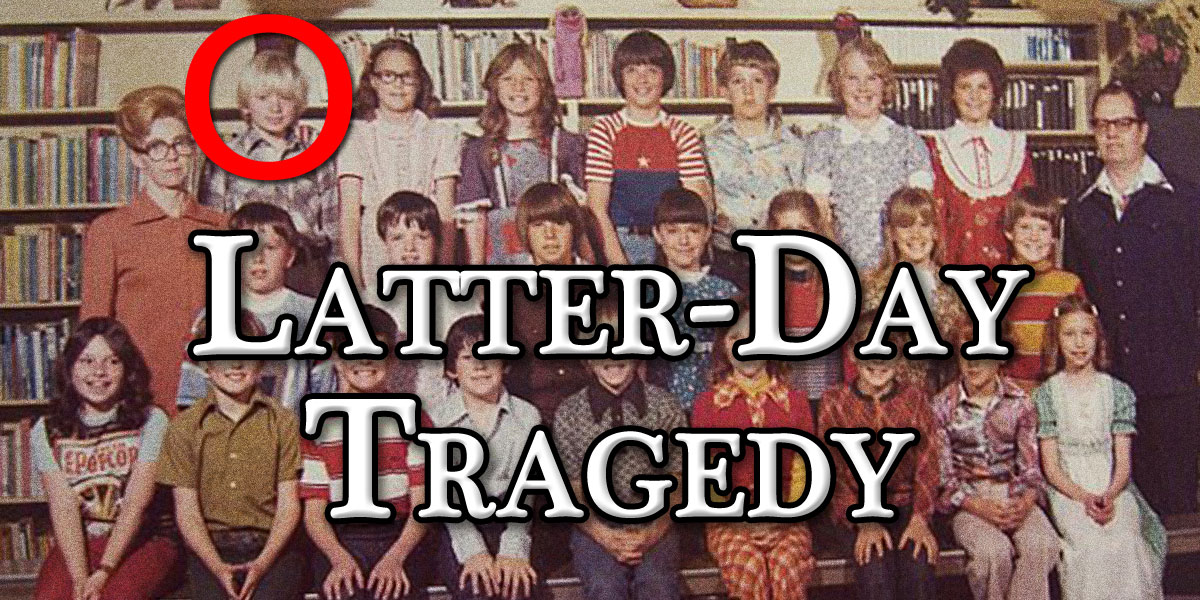
Kip Eliason, indicated in red.
Here Kip’s father and brother recount his experience:
Doctrinal and Prophetic Justification
Why would a young person feel that their life was worth losing over what they have been taught is sexual sin? Perhaps some of the following statements by LDS leaders have played a role:
“Some years ago the First Presidency said to the youth of the Church, “Better dead, clean, than alive, unclean” (In Conference Report, Apr. 1942, p. 89). I remember how my father impressed the seriousness of unchastity upon my mind. He and I were standing in the railroad station in Rexburg, Idaho, in the early morning of November 12, 1920. We heard the train whistle and knew that in three minutes I would be on my way to Australia to fill a mission. In that short interval my father said to me, among other things, “My son, you are going a long way from home. But your mother and I, your brother and sisters, will be with you constantly in our thoughts and prayers, we shall rejoice with you in your successes, and we shall sorrow with you in your disappointments. When you are released and return, we shall be glad to greet you and welcome you back into the family circle. But remember this, my son, we would rather come to this station and take your body off the train in a casket than to have you come home unclean, having lost your virtue.” I pondered that statement at the time. I did not then have the full understanding of it that my father had, but I have never forgotten it.”
(Marion G Romney, 2nd Counselor in 1st Presidency, April 1979 General Conference, lds.org)
Kip would have been 13 years old when he listened to this revered man of God teach this principle in the general conference of the church in 1979.
” There is no true Latter-day Saint who would not rather bury a son or a daughter than to have him or her lose his or her virtue—realizing that virtue is of more value than anything else in all the wide world”
(President Heber J Grant, Oct 1944 General Conference, archive.org)
With such high stakes placed on “virtue” (i.e. sexual moral purity) is it surprising that sincere young men who want to please God may experience such anguish?
“Your virtue is worth more than your life. Please, young folk, preserve your virtue even if you lose your lives.”
(President David O McKay as quoted by Spencer W Kimball, “The Miracle of Forgiveness”, pg. 63, archive.org)
Here a prophet makes a pro-active statement telling youth exactly what to do when face with a choice. A young man that struggles with his inability to refrain from masturbation may come to the conclusion that he is powerless to overcome it – making the choice between losing his life and “preserving his virtue” a dire ultimatum.
“Loss of virtue is too great a price to pay even for the preservation of one’s life – better dead clean, than alive unclean. Many is the faithful Latter-day Saint parent who has sent a son or a daughter on a mission or otherwise out into the world with the direction: “I would rather have you come back in a pine box with your virtue than return alive without it.”
(Bruce R. McConkie, “Mormon Doctrine”, 2nd edition, pg. 124 archive.org)
How is a young person who is just experiencing the powerful biological effects of their sexual development able to put these statements into context in their lives? Here they are told that faithful LDS parents should have this attitude of prioritizing sexual moral purity over life. Masturbation is anything but sexually pure according to LDS teachings. If their own parents are more understanding of the difficulties the youth has, now the youth have a reason to believe that their parents are not being as faithful as they should be. Imagine how Kip might have seen his father’s attempts to alleviate his guilt and shame in this context.
“…for we have received instructions from our youth, that the boy shall be as clean and as chaste as the girl ; that there is no double standard, and that each of us regards preservation of chastity as more precious than life itself”
(Apostle Melvin J Ballard, October 1937 General Conference, archive.org)
Here we learn that the same deathly warnings apply to both boys and girls.
“And now you young people – May I directly entreat you to be chaste. Please believe me when I say that chastity is worth more than life itself. This is the doctrine my parents taught me ; it is truth. Better die chaste than live unchaste. The salvation of your very souls is concerned in this.”
(J. Reuben Clark, 1st Counselor in 1st Presidency, October 1938 General Conference, archive.org)
The leaders of the church are the ones that members look to for truth. If you confront leaders today with this issue, they will certainly not go to the extent that these prior prophets and apostles have. Why is that? Has “truth” that J. Reuben Clark declared in 1938 or Romney described in 1979 changed in the intervening years? Have they disavowed this teaching?
Echoes of Blood Atonement
You may notice some similarity between the teachings of the church leaders here and those covered in the article on Blood Atonement. In fact, if the LDS leaders had truly believed those early prophets, then they might actually congratulate young Kip for having the courage to take his salvation into his own hands
“man may commit certain grievous sins—according to his light and knowledge—that will place him beyond the reach of the atoning blood of Christ. If then he would be saved he must make sacrifice of his own life to atone—so far as in his power lies—for that sin, for the blood of Christ alone under certain circumstances will not avail” (Doctrines of Salvation, by Joseph Fielding Smith, Salt Lake City, 1954, vol. 1, pp. 133-136, archive.org)
The parallels between the “better dead clean than alive dirty” idea and blood atonement are chilling. The represent an example of how a pernicious doctrine can seemingly disappear and yet be revealed to have woven itself into the fabric of the church.
Manipulations
In reality, such teachings are destructive. By taking a universal experience of normal human development and demonizing it, LDS leader create a lever of guilt and shame that can be used to control and manipulate church members. Each member keeps their secret shame hidden from others and believes that they are the only one who is unable to overcome the sin. If they do not have the spiritual experiences that they are taught they should be having, then they attribute it to their failure in “virtue”. They leaders tell them to read more, pray more, pay more, attend more meetings, and so on in order to overcome their weaknesses and so the members do just that in order to attempt to suppress their “sin”.
Ultimately the members either become excellent at lying in their various interviews (which are highly inappropriate to begin with) or they are honest and end up receiving multiple probations wherein they are forbidden from taking sacrament or holding certain callings. Ward members then see that there is something wrong with the member, and their imaginations are free to fill in whatever details come to mind. This sequence of events is not unique. Many former Mormon’s relate similar stories. There are former Bishops who have recounted stories of disciplining youth for the very sin that they themselves engaged in regularly.
Conclusion
Where in Christ’s ministry did he tell his followers that they should rather choose death than succumb to sin? The whole point of Christ’s atonement was to save people from sin – which Christians acknowledge all have committed. The central Christian message is that by turning one’s life over to Christ everyone can have their sin and guilt taken from them by Christ. Therein lies the peace and healing that are so characteristic of the Christian message. There should be no room for ultimatums of purity or death if you are actually Christian.
What do you do when you discover that your church, which claims to be Christian, completely misses the point of Christ’s message? Sinead O’Connor has recently released a new single called “Take me to Church” her chorus is as follows:
“Yeah, take me to church
I’ve done so many bad things it hurts
Yeah, get me to church,
but not the ones that hurt
‘Cause that ain’t the truth
And that’s not what it’s for”
(Sinead O’Connor “Take me to Church”)
I agree with her.
With such extreme statements as “better dead clean than alive unclean” is it any wonder that there are stories such as Kip Eliasons? While most youth do not go so far as to commit suicide – would you want your own child to be one of the few who do? Fortunately the church has backed down from such strong statements about masturbation in recent decades. While not imposing a choice between life and death, the strong messages about “self abuse” remain as leaders who were raised on the prior rhetoric continue to repeat it in youth classes, interviews and firesides. The effect is much more likely to simply damage a young person’s self confidence and give them a futile view of their own standing before God. This is a tragedy in and of itself.
PS
More information about the evolution of LDS attitudes towards masturbation is covered in this excellent Mormon Studies article.

Well put. I dealt with this growing up in the mormon faith. All of it. I am so glad to have found a different faith. It is real and the only way I made it out of a spiraling quest for sin and death was a Bishop telling me that it didn’t matter. The other things I was doing were way worse and who cared about the masterbation. Saved my life. That was one good man who cared more about me than my sin. Now I understand the real meaning of grace and live differently.
May I ask you, what is your new Church?
Why does it matter? Why do you think you need to know?
Why do you think you have a right to ask that question? Mind your own business.
Thanks for posting this. I was raised LDS through this era (I’m about a decade younger than Kip) so I also heard the same shaming. While they’ve lightened up a little bit, it’s still being done, and bishops still give The Miracle of Forgiveness for required reading to anyone “repenting”, and it’s got some of the same kind of sentiments there, including language that could cause a rape survivor to easily blame herself (if her bishop doesn’t do it first).
I’ve just written a book that deeply explores these problematic teachings, including shame, but many other pressures on Mormons, like demand for purity, threat of spiritual death, and methods for stripping identity away to replace it with the group’s identity. It’s based in social psychology research. It’s coming out July 22nd. I wrote it to help people heal for spiritual abuse, so if you know people who might be befit, please tell them. My website is http://www.recoveringagency.com
Thank you for posting this.
I grew up in the 50s and 60s in the Mormon church and I remember clearly the guilt and shame I felt for doing what should have been a natural part of who I was but the guilt led me to my first attempt at suicide because I knew I couldn’t ever live up to what was expected of me. The pressure the Mormon church put on me became unbearable. I attempted suicide 3 more times before I left the church and as crazy as it sounds the relief I found in drugs actually probably saved my life because it numbed the pain and guilt. T
here are so many skeletons in the Mormon church it is unbelievable. They are truly a cult that on the surface that they show the rest of the world is perfect and wonderful.
I am living proof that it is not what they want you to think it is. If you are struggling and need help please reach out to someone professional outside the church for help. Your life is worth so much more than what they put you through.
I’m glad you made it out. Don’t give up on the real God. He does exist and just wants you to know him. It doesn’t matter what church you go to as long as you know Him and believe that he died for your sins so you don’t have to. Christ’s righteousness covers our unrighteousness forever. We can’t totally stop sinning. We should try to live right but when we fall he doesn’t heap all our past sins on our head. He picks us up and says you can do better. He is there for us when we fail. Not to shame us but to love us. Take care.
So you’re listening in on a tragic and serious post in order to recruit people to yet another version of religion which still teaches people they aren’t whole without the approval of some mysterious being who apparently relies on a rabbIe of contradictory but self assured witnesses to convince you he’s reaI? I’m sure there’s more productive and charitable things you could be doing with your time.
No there is nothing better I could be doing with my time actually. I was writing to Roger to encourage him not to recruit him to any religion. I believe that there is a God who created everything that exists and made us moral agents in his image. Not physically but spiritually. If that’s not the case, as I assume you believe from reading your comment, how do you call what happened to that young man a tragedy? If God doesn’t exist All We Are is clumps of matter in a bag of skin. How do you get a tragedy from material stuff that has nothing spiritual or anything other than matter to its nature ?
Control and manipulate members?! This is really through the rabbit hole? So the bad feelings which they feel BEFORE they ever talk to a bishop or even really anyone were put there by that evil bishop….it’s all HIS fault. Let’s get him! Sounds like a lynch mob mentality at work here.
Never mind that if you mix gas, gun powder and styrofoam you get something flammable…but gosh dern it if it happens to explode well then god didn’t want you to go to church…. It’s a sign and if some vendor told you that gas was flammable and mixing chemicals might not be a good idea, he’s controlling you.
Ok maybe you won’t get what I’m saying there… Let’s look at an argument that plays out on the Simpsons.
In the Simpson’s episode “Much Apu About Nothing”, Ned Flanders spots a bear on the street, which prompts the whole town to crusade against bears and to create a Bear Patrol.
Homer: Not a bear in sight. The Bear Patrol must be working like a charm.
Lisa: That’s specious reasoning, Dad.
Homer: Thank you, dear.
Lisa: By your logic I could claim that this rock keeps tigers away.
Homer: Oh, how does it work?
Lisa: It doesn’t work.
Homer: Uh-huh.
Lisa: It’s just a stupid rock.
Homer: Uh-huh.
Lisa: But I don’t see any tigers around, do you?
[Homer thinks of this, then pulls out some money]
Homer: Lisa, I want to buy your rock.
[Lisa refuses at first, then takes the exchange]
Even as in this case it’s past that point… Yes it’s tragic, yes it’s sad, yes mistakes can occur in counseling, yes people bring a little bit of themselves to their callings, so on and so on… Mix it all up and you have the finished product. You can’t take a suicide and say,”You see!”, pointing to this mess of an experience and tragedy, ” that’s why you can’t do that!?” Anymore than you can point at an accident and say when the passenger didn’t survive the plane crash it was because his tray wasn’t in its full and upright position.
You’re an indoctrinated pos
Yes, but you can take the 100’s of suicides documented in the religious groups…. in of the corridors of the LDS faith and other rigid religions and wonder, why? Will you even concede that suicide is do to the possible teachings of the leaders…. I have heard the same rhetoric from the 12 and the President….. “Clean or Die”…… I paid particular attention to it as a convert in my 20’s! It hit me hard and I felt shameful of my normal life outside of the confines of the LDS faith. I was counseled by 2 Bishops and a Stake President before I was baptized, who told me I was to consider myself lucky if I got a good LDS man to marry me! I believed him…. I was new to it all and believed in the “shaming of not being virtuous enough for a RM…. dear Lord I did believe it then. What a fool I was. Tell me what part of this kind of teaching does not affect a young mind? Tell me if all of the people that mattered most to you taught and felt so strongly about this topic that it did not affect you at 16 years old….. tell me. It affected me at 21 and my brain was pretty much fully developed. I pity all of those lives cut short because they felt theirs was not good enough to live authentically.
If we are quoting the Simpson’s, let’s quote from the seventh season, episode 12 (episode 108 of the entire series): …Stan ends up shouting at the Mormons that they are ridiculous for believing in it without proof; they smile and patiently explain that it’s a matter of faith, while Stan argues that it should be a matter of empirical evidence. He further lashes out at them for acting unusually nice all the time, claiming it blindsides stupid people like his father into believing in Mormonism…..
I’d invite you to back off on the hyperbole and state your case simply and logically. Which bit of the influence/ effect chain are you having trouble seeing? The gist of your argument seems to be an inability to see a link between a promoted doctrine and a suicidal behavior. Is that it? Is that a general position you take on suicide or just the version for a Mormon defensive context?
When I read the story of Kip I was so angry! ALL Christian religion is based on The Bible, a book that no one can specifically say, who wrote it, what year- no what century, what millennium it was written in, what language it was written in. IT’S A BOOK! I would feel differently if GOD was to appear before me and personally convince me, but he has chosen not to. I think of the Christian martyrs, I think of those Jewish, Polish Gypsy families who were marched into the gas chambers, and how helpless they were. Where was GOD? If he is so powerful I cannot see ANY acceptable reason that would justify him not interceding and saving them, to believe otherwise is just STUPIDITY! I think of the Hogwash that is spouted about Christ dying for our sins. I ask the people who spout this specious belief what it means and what changed with Christ’s death, and they don’t know what to say.
To choose to believe in a GOD that would create a human with genitalia and then believe that HE/SHE or IT is some how observing if and when and how people are having sex, like this GREAT being is some kind of spiritual voyeur is pathetic, Why would HE/ SHE or IT even care if people masturbate? It’s so unimportant.
I think of all these “Religious” bible worshippers who live with frustration and no sex, and how at the end of heir lives there is NO Heaven( and simply put- no one can Prove it’s existence) what a waste it has been.
Please realize that because “It’s in The Bible” proves absolutely nothing!
I feel such compassion for Kip and his family. I hope that they have found some Peace in the World.
If your religious Faith is teaching you that manifested Sex is wrong, then you need to change your Faith, if you don’t you are being fooled and are indeed a FOOL!
So your argument is this;
There are evil people in this world full of free creatures.
I can’t understand why an all powerful God would let these free creatures harm each other.
Therefore he must not exist.
Or this;
I don’t know who wrote the books in the Bible.
I don’t even know when they wrote them or what language they wrote them in.
Therefore they can’t be truly from God.
And this;
If God were real he would personally appear to me to convince me that he exists.
He hasn’t done so.
Therefore he must not exist.
If Jesus really died for our sins anyone who believes that should be able to explain it to my satisfaction.
I’ve met some believers who couldn’t make me understand what it means.
Therefore it doesn’t have any validity.
How did I do?
Thank you for such a brave article. I loved it and agree 100% with you. The doctrine of the church is meant to shame and embarrass, cause us to question if we do anything remotely outside of the guide lines and doctrine it teaches. if we do we are shamed, taught to self hate until we tow the line again. Tragic, sorrowful, his death such a horrid example of Tribal Shaming!!! So glad I am out, not finished yet but— far enough away to pity those of my family still believing in this BS! They swallow it all hook, line and sinker.
I hope you can get through to your family. I also hope that you don’t give up on God. The LDS church doesn’t know the real God. You owe it to yourself to find out how reliable the text of the Bible really is. Joseph Smith had to create doubt in the Bible in order to convince the people that they needed a modern prophet. Now that you are free to look into “anti-mormon” sources you can find the truth in God’s Word. You won’t go to outer darkness because you left the church. That’s part of the mind control tactics they use to keep people from leaving. Good luck.
I’m a member of the church and had a lesson on this recently. If you commit a sin that breaks the law of chastity you need to repent for it. In the talks where they say it’s better to be dead but clean I think they really mean that when you die someday you will want to be clean in order to go live with Heavenly Father. I do not think they are saying that if you have trouble with this area of the gospel that you shouldn’t be living on this earth any more. I can see the way they say this is not the best they could have done.