

I previously described how anti-mormon material is primarily reproduction of actual church history from historical documents the church itself once produced. These explicit accounts lay bare the body of church history and have aptly been called “theological pornography”. The phenomena of the LDS church covering up its controversial or contradictory history to promote a cleaned up and modest image of the church is analogous to the internet phenomena of “bubble-p0rn” however is more aptly termed “Bubble-Modesty” in the context of church history and doctrine.
One complaint that I received from sharing quotes such as those in the first article on Bubble-Modesty was that I was using controversial quotes from the Journal of Discourses (JoD) and the History of the Church. When I grew up, we had these books in our library and I was always under the impression that they represented accurate and official church publications. Look at the publication history of the Journal of Discourses:
Journal of Discourses Background
The Journal of Discourses began as a publication by George D. Watt, the stenographer of Brigham Young. What is remarkable about this is that George D Watt was one of the few people who were trained in Pitman Shorthand. This skill allowed Watt to record sermons verbatim in a very reliable manner. He was able to earn a living for himself among the saints by publishing the sermons he recorded in the Journal of discourses.
Just watch the following video to see how Assistant Church Historian Richard E Turley Jr. and a church employed Pitman specialist, LaJean Carruth, praise George Watts ability and describe how this reliable method was used to record the sermons in the Journal of Discourses:
Turley: “George D Watt became the first person to take down the sermons word for word”
Carruth: “Pitman shorthand is a vast improvement over previous shorthands. Before that it was impossible to record things verbatim. In Pitman shorthand a skilled reporter could record things verbatim so you would have exactly what the person said”
(Video, “Deciphering Shorthand”, history.lds.org)
It is a good thing that Carruth came along and learned shorthand. Without her we would be stuck with these numerous records of old prophets written in an unknown hand. Before her we could only exclaim to ourselves “If only there was someone who had a sort of ‘power’ that could ‘translate’ unknown languages that contain God’s word as conveyed through his prophets on the earth!”
Prior endorsements of the Journal of Discourses
The first volume of the Journal of Discourses includes a letter from the First Presidency endorsing the “phonography” skills of Watt and advocating the sale and purchase of the sermons recorded in the journal said to be a work of “mutual benefit” (see full letter here). The letter was issued under the names of the First Presidency.
In 1963 a letter was sent by Deseret Books to an inquiring member confirming that the Journal of Discourses was indeed an official publication and that “that Deseret Book Company, being the only Church-owned book store, would not distribute literature on the Church, particularly anything as important as the Discourses of the Presidents and Apostles of the Church, without the approval of the Church” (see full letter here)
The Journal of Discourses is listed as an official Church publication in the following places:
- Essentials in Church History, by Joseph Fielding Smith, published by the LDS Church, p.674 (archive.org)
- Deseret News 1989-90 Church Almanac, p.188 (link currently unavailable)
- Referenced in numerous past church general conferences, manuals and publications. (more on this later)
Recent Inquiry
Even with this history of abundant official endorsement of the Journal of Discourses, members today may still wonder about it’s status. Indeed, that is what a close friend of mine did when I started sharing the various troubling things I found were taught by past leaders as recorded in the JoD and History of the Church. He wanted to find out if these texts were considered official (he wasn’t familiar with the preceding endorsements) and so he turned to the official Church History library in their “ask a librarian” feature and asked if the JoD and History of the Church were “reliable sources to the church.” He received an email answer a few days later from a reference librarian with the following statement:
“Here is a link to the Encyclopedia of Mormonism article on the Journal of Discourses. This is not considered an official publication of the Church and Church publications do not source from the Journal of Discourses. Editors of Church publications will instead try to find the original talk as published in the Deseret News.
Here is a link to a 2008 Church News article which discusses the History of the Church. Again, these volumes (like the Journal of Discourses) are not considered scripture and the same care as recording scripture was not taken in recording this information. The new edition of the Doctrine and Covenants has removed all references to this collection from its section headings.”
-(Email response from Church History Librarian, 3 Sept 2013 archive.org)
This response represents the current position of the church. Quite a difference from the previously described endorsements – particularly the video with Bro. Turley, the assistant church historian. What is funny is that the video with Turley above was recently made and the whole point of the video is to celebrate the fact that Watts shorthand ability was remarkable for it’s fidelity to what was actually said by the speakers – that it was the closest thing to audio recording that existed at that time.
Think about it this way – they are denouncing the JoD and yet putting up sermons transcribed by Carruth on the official LDS.org website as “lost sermons” and giving them the weight of official material. Carruth is no doubt very skilled at deciphering Pitman Shorthand, but they are giving her renditions of Watt’s notes over a century after the fact greater validity that Watt’s own transcriptions of his notes published by himself during his lifetime. That is a major inconsistency.
Checking the disavowal
Note that the librarian made a statement of fact in her response: “Church publications do not source from the Journal of Discourses” is this true?
You can search the LDS website for the phrase “journal of discourses” to see how many times it is referenced in the various articles and manuals hosted there. Lets try that query:

general Query for the words journal of discourses at lds.org returns 22 pages of 20 hits each
Here you can see that there are no less than 22 pages of 20 hits each returned for the search terms.
Now that we can search for the Journal of Discourses in the search engine – what do we find? There are many many manuals that reference the Journal of Discourses. These range from the 1997 Primary 5 manual, which cites the JoD in 5 of it’s lessons, to the 2000 Doctrines of the Gospel Teacher Manual which references sermons from the Journal of Discourses 16 times. Also:
- 2002 Doctrine and Covenants Student Manual
- 2000 Pearl of Great Price Student Manual
- 2002 Old Testament Seminary Student Study Guide
- 1982 Old Testament Student Manual Kings-Malachi
- 2003 New Testament: Student Study guide
- 2009 Doctrine and Covenants and Church History Student Study Guide
- 2004 Presidents of the Church Student Manual (while this shows up as a result in the search engine query, you get an error when trying to select the link. this institute manual was available at lds.org in Jan 2013, archived at the internet wayback machine, however is now only found in PDF form on ldsces.org)
- 2005 Presidents of the Church Teacher Manual
Each of the above links contains a reference to the Journal of Discourses in a manual currently published on official Church servers.
More importantly, if you perform a general search for Journal of Discourses you will find numerous hits in the “General Conference” section of the website – see this query. Looking for recent conference talks you can find a talk from the April 2012 General Conference entitled “The Doctrine of Christ” by Elder D. Todd Christofferson which references a quote from Brigham Young from Journal of Discourses, 12:69 (see footnote #1 on that page). If an Apostle speaking about the “Doctrine of Christ” in general conference can cite the Journal of Discourses, then clearly it is considered authoritative. Since this talk and it’s references were published in the record of the April 2012 General Conference, then the statement by the Church Librarian that “Church publications do not source from the Journal of Discourses” is decidedly false.
A Different Tactic
Perhaps it is only the old manuals that use the JoD as reference. In fact it may be that at some time in the past couple of decades a policy was made that official publications should no longer reference the JoD going forward. Lets examine that assertion.
Brigham Young is by far the most recorded prophet in the Journal of Discourses. Much of our knowledge of Brigham Young’s teachings come from sermons recorded in the JoD.
The relatively recent manual “The Teachings of the Presidents of the Church: Brigham Young” (available here in PDF), was published in 1997. If you search for the phrase “Journal of Discourses” in this manual you will find one match in the listing of references used in the manual. This list indicates that the abbreviation JD will be used anywhere the Journal of Discourses is referenced. If you then search the manual for ‘JD‘ you will find that it is not referenced anywhere in the manual. The Journal of Discourses is not cited anywhere in the entire manual. So where did the abundant quotations from Brigham Young included in the manual come from?
Another one of the references cited on page 360 is “Discourses of Brigham Young. Selected by John A. Widtsoe. 1941” which is abbreviated DBY in the manual. If you do a search for “DBY” you will find that there are almost 1200 references to this 1941 text. This appears to be the authoritative text of Brigham Young’s recorded ministry.
“Discourses of Brigham Young” a subset of the Journal of Discourses.
A scanned version of “Discourses of Brigham Young” selected by John A Widtsoe is available in digital form online at archive.org. If you examine the preface of the book you will find the following:
“This book was made possible because Brigham Young secured stenographic reports of his addresses, As he traveled among the people, reporters accompanied him. All that he said was recorded. Practically all of these discourses (from December 16, 1851 to August 19, 1877) were published in the Journal of Discourses, which was widely distributed.”
(“Discourses of Brigham Young” selected by John A Widtsoe, preface page v, archive.org)
It turns out that this 1941 book of selected sermons of Brigham Young is just a subset of the sermons recorded in the Journal of Discourses. Does this book include some of the controversial sermons of Brigham Young? Well, lets check.
The sermon of 9 April 1852 is one of Brigham Young’s most controversial sermons as it is his introduction of the teaching that Adam was God the Father and the “only God with whom we have to do.” Is this sermon included in Widtsoe’s selections for his 1941 book? Nope.
The sermon of 9 October 1859 includes extremely racist remarks which includes teachings that have been disavowed by a recent essay on race and the priesthood. Was this sermon included in the 1941 compilation? Nope again.
The sermon of 8 February 1857 included teachings on Blood Atonement that any modern mormon would find reprehensible. Was this sermon included in the “Discourses of Brigham Young”? Absolutely not.
You see, what the church has done is to take a second book, “Discourses of Brigham Young,” which is simply a cherry picked collection of the non-controversial sermons from the Journal of Discourses and then treated that book as a reliable reference. In this way, the church can pretend that those embarrassing sermons seen in their full and uncensored forms in the Journal of Discourses were somehow never official or reliable. The church can treat this artificially sterilized and constructed book as authoritative and reference it all over their manuals and publications and then disavow the Journal of Discourses. That is how the Church librarian can honestly state that “church publications do not source from the journal of discourses.” Does this strike you as honest?
This is the very definition of Bubble-Modesty. It is also known as whitewashing, revisionism and outright deception.
The Ecclesiastical Ministry of Truth
This is the sort of stuff that we expect to see from Communist China or in an dystopian totalitarian society depicted in a George Orwell novel – not in a religious organization purporting to advocate notions of free agency. Remember that witholding information from investigators or members deprives them of informed consent and is antithetical to free agency.
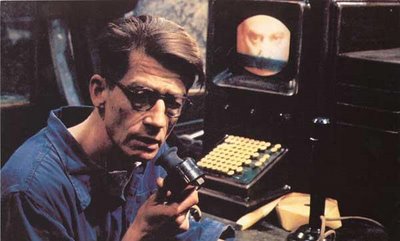
Winston Smith, changing history in the Ministry of Truth
In the prescient novel “Nineteen Eighty-Four” by George Orwell, the protagonist Winston works in the records department of the Ministry of Truth. Despite the name of the department, his job is to rewrite history so that it matches the current and constantly changing policy of the ruling party. In some cases this involves altering photographs, deleting or changing news clippings or recordings. By doing so the members of the public would find a consistent narrative if they searched for any information to support the claims of the government. This allowed the controlling and domineering government to avoid accountability and maintain control over the minds of both lower level party members and the ‘proles’ (the low level working class).
Creating sterilized accounts of early church leaders sermons and then holding up those whitewashed records as authoritative while disavowing the original source of the Journal of Discourses is flat out dishonest. They have done similar things with the History of The Church and numerous other books, previously published by the church are now considered “not official” and as such when people bring up those accounts of early church history and doctrine they are dismissed without further thought by defenders of the faith. Here is an apt depiction of this form of bubble modesty:
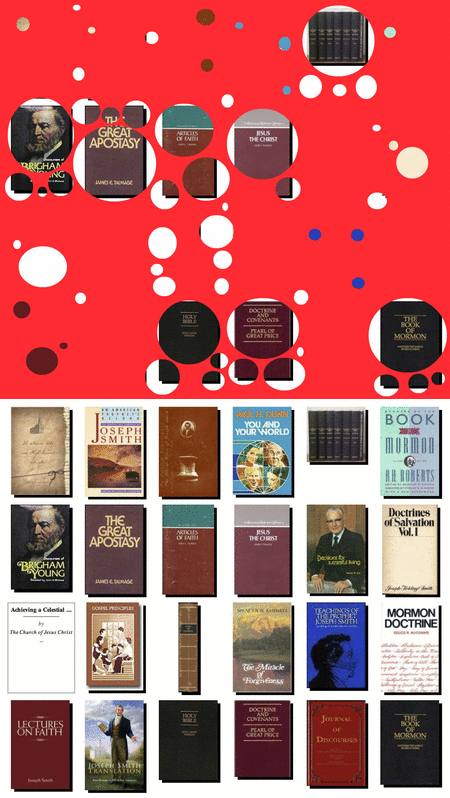
Bubble-Modesty of books
Conclusion
1984 and the government of Big Brother is not just a cautionary tale for governments and political power. It is a fable which instructs it’s readers in the methods that controlling and unethical organizations maintain their control over the minds of their willing subjects. This extends beyond government and can be seen in religion, corporations or even the military. The thing is, once you know about the tactics then if you see your revered organization using them – you should immediately be alarmed and dig deeper to see exactly what that organization is hiding from you.
As an American, you would likely encourage a North Korean citizen to seek information outside of the controlled information that North Korea allows so that they can see the context of the broader world. As a Mormon, you would likely encourage a Jehovahs Witness or a Scientologist to look for information about their church provided by people who aren’t part of the leadership structure. Those leaders have a motive to conceal embarrassing or conflicting information which would reveals those traditions to be false. As a Mormon, you would want them to discover the deception so that they might have a chance to join the LDS Church. Should it not concern you that the leaders of the LDS Church are themselves attempting to control where you can get your own information about the church itself? They are going so far as to misinform members that certain texts are not official or cited in official publications and cover up past leaders sermons – shouldn’t that be a red flag? If it is detrimental to JW’s, scientologists, moonies, communists or any other group of people under the control of an authoritative hierarchy, isn’t it also detrimental to free thinking Mormons? Think about it.
Big Brother would be proud.

As usual, great stuff. Thank you again for all of your hard work.
Thanks, please take another look at the article to note the update – Additional testing of the lds.org search engine has revealed a more likely explanation than intentional search filtering. See the article for retractions and details.
(sigh)
I know.
I love you, Jon. We disagree, but, I love you just the same, never forget that.
Translation: I’ve got nothing so I will communicate a passive aggressive sigh. lol
Hello Jenny,
No, I always hesitate and try to think what should I say. Should I say anything? Should I try to clamp down on every contrary point of view and push my brother’s face into every counter argument I can make? Sometimes you mow the grass…sometimes you let it go for a weekend. I am paid a very poor wage for my efforts, so besides showing a particle of restraint, I think I should also be allowed to rest from time to time. I can’t live Jon’s life for him, otherwise it would be my life and then this would be a very different type of conversation.
Would you really want to encourage me to rob his wife of time he spends writing to me instead of spending it with his wife and his children? I mean after all one of us is expending a lot of time on a lost cause, right? Wouldn’t it be better if it was spent doing something that no matter what the outcome of “these” conversations, it was instead something that was worthwhile and couldn’t be swept away as dross?
Whatever the outcome maybe, I wish you well and I do continue to hold Jon, his wife and *all* of his family in my prayers. I am difficult sometimes, after all I am family, but I hope because I am conscious of my stubbornness, because I will always persist in being here no matter how I am wrong or how I am stupid or fat or ignorant…tenacity, loyalty and persistence is what I do have, and I will stick with him despite the “bellowing of the blast”, because he and his are very, very precious to me.
– Love Spence.