

[toc]Anyone familiar with the history of the translation of the Book of Mormon will recall that the first 116 pages of the translation, the contents of the “Book of Lehi,” were lost.
The lost pages
The Encyclopedia of Mormonism summarizes the story here:
“In June 1828 Martin Harris asked Joseph Smith repeatedly to allow him to show the 116 pages to family members to allay their skepticism and criticism of the translation. After prayerful inquiry of the Lord, Joseph Smith twice emphatically denied these requests. As Joseph’s 1832 and 1839 histories indicate, a third request received divine permission for Harris to take the 116 manuscript pages to Palmyra, New York. The Prophet required Harris to solemnly covenant that he would show them only to his brother, his parents, his wife, and her sister.
Harris’s failure to return to Harmony as promised caused Joseph great anxiety and necessitated a strenuous journey to Manchester. There, a reluctant Harris reported that someone had stolen the manuscript from his home after he had broken his covenant and indiscriminately showed it to persons outside his family. Grief-stricken, Joseph Smith readily shared responsibility for the loss. The most widespread rumor was that Harris’ wife, irritated at having earlier been denied a glimpse of the ancient plates, had removed the manuscript translation from Martin’s unlocked bureau and burned it. Not long afterward, she and Martin separated.”
(“Manuscript, Lost 116 Pages” Encyclopedia of Mormonism, byu.edu)
Chastisement, repentance and warning
After this shameful event, Joseph Smith temporarily lost custody of the Golden Plates and Urim and Thummim and was chastised by the Lord, as recorded in D&C 3. After a period of humility and repentance, Joseph had the plates restored to him and was again commanded to translate – only he was forbidden to repeat the translation of the first 116 pages. This was to avoid a trap was had been laid by Satan acting through evil men who had stolen the 116 pages. In D&C 10 the Lord reveals:
“And, behold, Satan hath put it into their hearts to alter the words which you have caused to be written, or which you have translated, which have gone out of your hands. And behold, I say unto you, that because they have altered the words, they read contrary from that which you translated and caused to be written; And, on this wise, the devil has sought to lay a cunning plan, that he may destroy this work; For he hath put into their hearts to do this, that by lying they may say they have caught you in the words which you have pretended to translate.”
(Doctrine and Covenants 10:10-13, lds.org)
Here the Lord is warning Joseph of the trap and describing the means whereby these evil men would try to destroy Joseph Smith’s reputation and credibility. The Lord continues in describing exactly what the effect of having such a false contradiction of prophetic translation would be:
“And if God giveth him power again, or if he translates again, or, in other words, if he bringeth forth the same words, behold, we have the same with us, and we have altered them; Therefore they will not agree, and we will say that he has lied in his words, and that he has no gift, and that he has no power; Therefore we will destroy him, and also the work; and we will do this that we may not be ashamed in the end, and that we may get glory of the world.”
(Doctrine and Covenants 10:17-19, lds.org)
By altering the original translated words and demonstrating that they do not match any repeat translation that Joseph would have performed, the evil men were hoping to portray Joseph as a liar without power or gift from God. The fact that the Lord forbade Joseph from retranslating the document is evidence that the designs of these men would have been successful.
Crisis Averted
Fortunately, the Lord had foreknowledge of these events and had inspired the authors of the Golden Plates to reproduce most of the events in the Book of Lehi in the first few books of the remainder of the Book of Mormon (see Words of Mormon 1:7). As a result, even though Joseph did not repeat the translation of the first 116 pages, no essential scripture was lost and his reputation and credibility as a translator remained intact.
Hypothetical
The cunning plan of the adversary revealed in D&C 10 was certainly a warning of the evil designs of men who would fight against the Lord’s purpose. If they had produced a document as a proof against any retranslation that Joseph made of the first 116 pages – the followers of Joseph Smith would at least have viewed the motives of those men suspiciously and treated their efforts with skepticism.
What if the lost 116 pages had not fallen into the hands of evil men, but had just been temporarily misplaced? Imagine that this happened and the Lord had not forbidden a retranslation. Since there were no evil men to threaten changing the words, then there would have been no threat. If that lost first translation had been rediscovered, you would imagine that the words produced would match those of the repeat translation. After all, it is the fabricated mismatch of words of the two translations that the Lord warns will give evil men the ability to discredit the Prophet in D&C 10. If there were no evil men to fabricate a mismatch by altering the words – then one could reasonably expect that no significant differences between the texts should exist.
In such a hypothetical situation, to rediscover the original 116 pages and find that they are almost identical to the repeat translation would be a true testament of the gift and power of Joseph Smith as a translator! If such an event would be testament to the Prophet’s calling and gift, finding that they contradicted or were dissimilar from each other would at least present some provocative questions.
Hypothetical Realized
Well, we don’t have to just imagine such a scenario. This actually happened – though not with the translation of the Book of Mormon, but rather with a portion of the inspired new translation of the New Testament. It takes a bit of explaining, but is well worth the time.
[Note: The following information was thoroughly researched and documented by a BYU professor of Ancient Scripture in a BYU Studies publication from 2003]
The Story of the Twice Translated Scripture
Shortly after the publication of the Book of Mormon and the organization of the Church of Christ Joseph Smith began work on a new translation of the Bible in June of 1830. This new translation began with the revelation now known as the Book of Moses, which serves as a preface to the book of Genesis. From June 1830 to March 1831, Joseph Smith continued to translate the Old Testament, starting with Genesis.
On March 7, 1831 the revelation now known as D&C 45 was received and in it Joseph Smith was instructed to interrupt his translation of the Old Testament and complete a full translation of the New Testament (D&C 45:60-62). This he commenced to do in sequence from Matthew to Revelation between March 1831 and July 1832.

A page from Matthew 26 of NT1
On March 8, 1831 translation of the New Testament began and Matthew 1:1 through Matthew 26:71 were dictated and recorded by scribe Sidney Rigdon into a manuscript now designated New Testament Manuscript 1 (NT1). With this much completed, there was an interruption in the translation as Joseph Smith and Sidney Rigdon traveled from Kirtland Ohio to Independence Missouri in June of 1831.
In the revelation now known as D&C 47 John Whitmer was appointed to transcribe for Joseph Smith (D&C 47:1). As a transcriptionist Whitmer would take the manuscripts that were directly recorded from dictation by Joseph Smith’s scribes (which included the scribe’s own corrections and markups) and transcribe them into a separate folio which could then be edited by Joseph Smith. In fulfillment of this appointment Whitmer began by transcribing the completed portions of the Old Testament translation and then doing the same for the pages of the NT1 manuscript as they became available. By the time of this early interruption in the New Testament translation, Whitmer had transcribed the completed portions of NT1 up to Matthew 26:1 onto a new manuscript now designated New Testament Manuscript 2, Folio 1 (NT2.1).
Importantly, the remainder of Matthew Chapter 26 up to verse 71, which was recorded on NT1, was not transcribed onto NT2.1.
After returning to Kirtland Ohio at the end of summer of 1831, Joseph Smith commenced his work on his translation of the New Testament. While Sidney Rigdon acted as scribe previously, John Whitmer now assumed that duty. It appears that both Whitmer and Joseph Smith reviewed the work which had been transcribed onto NT2.1 and assumed that the last transcribed verse, Matthew 26:1, was the stopping point of the previous work – forgetting that Matthew 26 had previously been translated and recorded in the NT1 manuscript. As such, the recommencement of the New Testament translation began at the beginning of Matthew 26 and on through Revelation over the next year. John Whitmer began recording this new translated material in a new manuscript now designated New Testament Manuscript 2, Folio 2 (NT2.2).
It appears that after the initial transcription of NT1, it was no longer used in the editorial process. The new new translation of Matthew 26 was recorded in NT2.2 and it was this version which was incorporated into the final Inspired Translation of the New Testament which Joseph Smith recorded in his journal to be complete on 2 Feb 1833. (History of the Church, 1:324.)
As a result of this sequence of events, there exists two inspired translations of Matthew 26. The first version recorded in NT1 did not had the benefit of editorial review by Joseph Smith and was only rediscovered after scholarly study of the original manuscripts by historians of the Reorganized Church of Jesus Christ of Latter-day Saints. The second version recorded in NT2.2 is now part of official LDS scripture, with excerpts being included in footnotes in the Church’s published version of the New Testament.
Tracking the Changes
At the end of this article I have included a table with the text of the original KJV of Matthew 26 as well as the NT1 and NT2.2 translations. The first column contains the KJV text and the second and third columns contain the NT1 and NT2.2 translations respectively, marked up to show how they differ from the KJV text. Words which have been deleted are struckthrough in red and words which have been added are underlined in green.
Significant differences
Whether or not there is a significant difference between the two translations is a decision best left to the reader. Since there are no evil men conspiring to change words in the mix, the differences must be considered the legitimate product of Joseph Smith’s purported gift of translation. One may add the caveat that Joseph did not have the opportunity to make editorial corrections to the NT1 translation and so such a comparison is not valid, however if you look at the sorts of editorial corrections that are made to other parts of the the inspired translations, you will not find differences quite so dramatic and frequent as those between NT1 and NT2.2.
The only faithful LDS perspective analysis of these two translations that I have see is the document which alerted me to them in the first place, co-authored by Kent Jackson, a Professor of Ancient Scripture at BYU, and Peter Jasinski, and editor and BYU alumn (“The Process of Inspired Translation” BYU Studies Volume 42:2 (2003)) In that analysis several differences are described and the authors still find the differences to support Joseph’s gifts of translation.
The reader is invited to review that article for a full analysis of all the differences, however I will include what I believe to be the most revealing differences here.
Verse 25-26 – Missing words of Christ

Comparison of Matt 26:25-26
In the 3 column comparison above it is noted that there are quotations from Jesus Christ in the NT! text (highlighted in yellow) which clarify Christ’s statements as compared to the KJV and NT2.2 text. Why would these additional words of the Savior not be included in the final inspired version? It seems odd to have the very words of the Lord Christ revealed one day and then forgotten the next by one who is supposed to have the power to reveal such important things. There are numerous examples of missing words of Christ which were added to NT1 and subsequently not included in NT2.2. Fortunately most of these do not significantly change the scripture (a telling fact in and of itself).
Verse 50 – Who is Christ talking to?
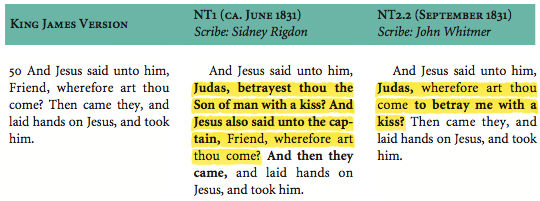
Comparison of Matthew 26:50
Verse 50 presents a particularly challenging conflict. In the NT1 translation Christ is quoted as asking Judas “betrayest thou the Son of Man with a kiss?” and then asking the Captain of the soldiers which came with Judas the question “Friend, wherefore art thou come?” In the NT2.2 translation Christ asks Judas both questions and the Captain of the soldiers is not mentioned at all. Why would the target of Christ’s question be changed between accounts if the Gift and Power of God was used in providing a true translation?
Verse 61-63 – Missing insignificant changes

Comparison of Matt 26: 61-63
In these verses it is notable that The NT1 text includes some re-ordering of phrasing compared to the KJV, but most of that rewording is not repeated in the NT2.2 translation. It is unavoidable to notice that the rewording does not add anything to the verses (which is true of an overwhelming majority of the changes) and that when the Prophet retranslated the verses he was not inspired to make such changes. This doesn’t even touch the numerous insignificant changes which are not present in the NT1 translation which get added to the NT2.2 document.
Verse 66 – Uninspired Blooper
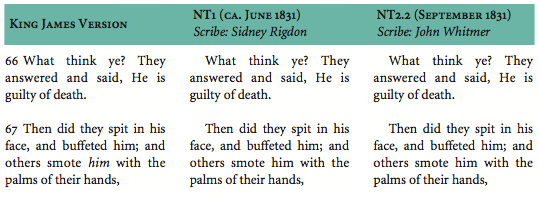
Comparison Matthew 26:66-67
This item is not actually related to the prophetic work of Joseph Smith. As you can see this verse is not changed in either the NT1 or the NT2.2 document. Now take a look at your official LDS scriptures for the footnote 66b. This is what it looks like at the official LDS.org scriptures:

Matthew 26:66 footnote b on lds.org
You can see in the footnote that it says the text is expanded in the Joseph Smith Translation to include “worthy of death.” This is reflected in the Inspired Version of the Bible which has been published by the Community of Christ (Reorganized Church of Jesus Christ of Latter-day Saints) where it reads “…He is guilty, and worthy of death.” The problem is that when you examine the original manuscript of NT2.2 this addition is not part of the original work of Joseph Smith or his scribes. It was an addition written in pencil on the NT2.2 manuscript by the publication committee of the RLDS in preparation for the printing of their original Inspired Version.
The change is in the handwriting of Joseph Smith III.
That’s right. There is new scripture in the official published version of the LDS scriptures which came from the hand of a man who did not have the Priesthood, did not have the keys or gift of translating and who could only be considered a pretender to the rights and power which Joseph Smith held. The question is not “how could this man have been given the power to reveal scripture?” but rather “how could the authorized agent of the church who selected passages for inclusion in LDS scripture footnotes (read Bruce R. McConkie) not be inspired enough to tell the difference between the handwriting of the Prophet and that of of his uninspired son or sensitive enough to distinguish legitimate revealed scripture from illegitimate scripture?”
Good question.
Fortunately, like most of the other changes, these aberrations don’t actually add anything of significant worth to the scripture.
Conclusion
Since these findings were published by respected faithful LDS scholars in 2003 and there has been no widespread outcry that Joseph Smith was a fraud and a charlatan only pretending to powers of translation, it can be asserted that there is a chance that the Lord’s warning about the evil designs of conspiring men waiting to show inconsistencies in the original 116 pages were overblown. With the twice translated Matthew Chapter 26 it appears that scholars simply shrug and go about their careers and members are not even aware of the existence of a potential problem. (I certainly wasn’t). It appears that fear of the lost 116 pages was pointless.
The critics of Joseph Smith will certainly see this as another objective proof of the fraudulent character of Joseph Smith. Believing members will, at least, have to acknowledge that the notion of revelation and translation occurring in a way that involves reproducible and consistent truth is not accurate. In fact, the banality of the overwhelming majority of changes and additions to the scripture would seem to belittle the power that was claimed in making those changes. Many of the changes were done to update the words to more modern usage, but NIV and other modern translations have done the same, with arguably more comprehensible results. Since no real additional doctrine was added to the JST translation here – why are the NIV and other translations not just as legitimate? If it is because those non-lds tranlsators did not have the gift and power ordained of God – why was an addition by Joseph Smith’s non-priesthood holding son included?
These questions may never produce satisfactory answers in the mind of those who continue to hold on to preconceived ideals about how Joseph Smith’s powers of translation operated. There are really only two options – to acknowledge that Joseph Smith was not inspired or empowered as he claimed or to redefine in one’s mind what it means to translate or receive revelation.
Appendix 1 – Track Changes Comparison of Matthew 26
| King James Version | NT1 (ca. June 1831) Scribe: Sidney Rigdon | NT2.2 (Sept 1831) Scribe: John Whitmer |
|---|---|---|
| 1: And it came to pass, when Jesus had finished all these sayings, he said unto his disciples, | And it came to pass, when Jesus had finished all these sayings, he said unto his disciples | And it came to pass, when Jesus had finished all these sayings, he said unto his disciples |
| 2: Ye know that after two days is the feast of the passover, and the Son of man is betrayed to be crucified. | Ye know that after two days is the |
|
| 3: Then assembled together the chief priests, and the scribes, and the elders of the people, unto the palace of the high priest, who was called Caiaphas, | And then assembled together the chief priests, and the scribes, and the elders of the people, unto the palace of the high priest, who |
Then assembled together the chief priests, and the scribes, and the elders of the people, unto the palace of the high priest, who was called Caiaphas |
| 4: And consulted that they might take Jesus by subtilty, and kill him. | And consulted that they might take Jesus by subtilty, and kill him, that they might put an end to his work | And consulted that they might take Jesus by subtilty, and kill him |
| 5: But they said, Not on the feast day, lest there be an uproar among the people. | But they said, |
But they said, Not on the feast day, lest there be an uproar among the people |
| 6: Now when Jesus was in Bethany, in the house of Simon the leper, | Now when Jesus was in Bethany, in the house of Simon the leper | Now when Jesus was in Bethany, in the house of Simon the leper |
| 7: There came unto him a woman having an alabaster box of very precious ointment, and poured it on his head, as he sat at meat. | There came unto him a woman having an alabaster box of very precious ointment, and poured it on his head, as he sat |
There came unto him a woman having an alabaster box of very precious ointment, and poured it on his head, as he sat |
| 8: But when his disciples saw it, they had indignation, saying, To what purpose is this waste? | But when his disciples saw |
But when |
| 9: For this ointment might have been sold for much, and given to the poor. | For this ointment might have been sold for much, and given to the poor | For this ointment might have been sold for much, and given to the poor |
| 10: When Jesus understood it, he said unto them, Why trouble ye the woman? for she hath wrought a good work upon me. | When they had said thus, Jesus understood |
|
| 11: For ye have the poor always with you; but me ye have not always. | For |
For ye have the poor always with you; but me ye have not always |
| 12: For in that she hath poured this ointment on my body, she did it for my burial. | For |
|
| 13: Verily I say unto you, Wheresoever this gospel shall be preached in the whole world, there shall also this, that this woman hath done, be told for a memorial of her. | Verily I say unto you, Wheresoever this gospel shall be preached in the whole world, |
And in this thing that she hath done, she shall be blessed. Forverily I say unto you, Wheresoever this gospel shall be preached in the whole world, |
| 14: Then one of the twelve, called Judas Iscariot, went unto the chief priests, | Then one of the twelve, called Judas Iscariot, went unto the chief priests | Then one of the twelve, called Judas Iscariot, went unto the chief priests |
| 15: And said unto them, What will ye give me, and I will deliver him unto you? And they covenanted with him for thirty pieces of silver. | And said |
And said |
| 16: And from that time he sought opportunity to betray him. | And from that time he sought opportunity to betray him | And from that time he sought opportunity to betray |
| 17: Now the first day of the feast of unleavened bread the disciples came to Jesus, saying unto him, Where wilt thou that we prepare for thee to eat the passover? | Now on the first day of the |
Now on the first day of the feast of unleavened bread the disciples came |
| 18: And he said, Go into the city to such a man, and say unto him, The Master saith, My time is at hand; I will keep the passover at thy house with my disciples. | And he said, Go into the city to such a man, and say unto him, The Master saith, My time is at hand; I will keep the passover at thy house with my disciples | And he said, Go into the city to such a man, and say unto him, The Master saith, My time is at hand; I will keep the passover at thy house with my disciples |
| 19: And the disciples did as Jesus had appointed them; and they made ready the passover. | And the disciples did as Jesus had |
And the disciples did as Jesus |
| 20: Now when the even was come, he sat down with the twelve. | Now when the even was come, he sat down with the twelve | Now when the |
| 21: And as they did eat, he said, Verily I say unto you, that one of you shall betray me. | And as they did eat, he said, Verily I say unto you, that one of you shall betray me | And as they did eat, he said, Verily I say unto you, that one of you shall betray me |
| 22: And they were exceeding sorrowful, and began every one of them to say unto him, Lord, is it I? | And they were exceeding sorrowful, and began every one of them to say unto him, Lord, is it I | And they were exceeding sorrowful, and began every one of them to say unto him, Lord, is it I |
| 23: And he answered and said, He that dippeth his hand with me in the dish, the same shall betray me. | And he answered and said, He that dippeth his hand with me in the dish, the same shall betray me | And he answered and said, He that dippeth his hand with me in the dish, the same shall betray me |
| 24: The Son of man goeth as it is written of him: but woe unto that man by whom the Son of man is betrayed! it had been good for that man if he had not been born. | The Son of man goeth as it is written of him: but woe unto that man by whom the Son of man is betrayed! it had been good for that man if [he] had not been born | But the Son of man goeth as it is written of him: but woe unto that man by whom the Son of man is betrayed! it had been good for that man if he had not been born |
| 25: Then Judas, which betrayed him, answered and said, Master, is it I? He said unto him, Thou hast said. | Then Judas, which betrayed him, answered and said, Master, is it I? He said unto him, Thou hast said truly, for thou art the man | Then Judas, |
| 26: And as they were eating, Jesus took bread, and blessed it, and brake it, and gave it to the disciples, and said, Take, eat; this is my body. | And as they were eating, Jesus took bread, and blessed it, and brake it, and gave it to the disciples, and said, Take, eat |
And as they were eating, Jesus took bread, and brake it, andblessed it, and |
| 27: And he took the cup, and gave thanks, and gave it to them, saying, Drink ye all of it; | And he took the cup, and gave thanks, and blessed the cup, andgave |
And he took the cup, and gave thanks, and gave it to them, saying, Drink ye all of it |
| 28: For this is my blood of the new testament, which is shed for many for the remission of sins. | For this |
For this is in remembrance of my blood of the new testament, which is shed for as many as shall believe on my name, for the remission of their sins. And I give unto you a commandment, that ye shall observe to do the things which ye have seen me do, and bear record of me even unto the end. |
| 29: But I say unto you, I will not drink henceforth of this fruit of the vine, until that day when I drink it new with you in my Father’s kingdom. | But I say unto you, I will not drink henceforth of this fruit of the vine, until that day when Ishall come and drink it new with you in my Father’s kingdom | But I say unto you, I will not drink henceforth of this fruit of the vine, until that day when I drink it new with you in my Father’s kingdom |
| 30: And when they had sung an hymn, they went out into the mount of Olives. | And when they had sung |
And when they had sung |
| 31: Then saith Jesus unto them, All ye shall be offended because of me this night: for it is written, I will smite the shepherd, and the sheep of the flock shall be scattered abroad. | Then saith Jesus unto them, All |
Then |
| 32: But after I am risen again, I will go before you into Galilee. | But after I am risen again, I will go before you into Galilee | But after I am risen again, I will go before you into Galilee |
| 33: Peter answered and said unto him, Though all men shall be offended because of thee, yet will I never be offended. | But Peter answered and said unto him, Though all |
Peter answered and said unto him, Though all men shall be offended because of thee, |
| 34: Jesus said unto him, Verily I say unto thee, That this night, before the cock crow, thou shalt deny me thrice. | Jesus said unto him, Verily I say unto thee, That this night, before the cock crow, thou shalt deny me thrice | Jesus said unto him, Verily I say unto thee, That this night, before the cock crow, thou shalt deny me thrice |
| 35: Peter said unto him, Though I should die with thee, yet will I not deny thee. Likewise also said all the disciples. | Peter said unto him, Though I should die with thee, yet I will |
Peter said unto him, Though I should die with thee, yet will I not deny thee. Likewise also said all the disciples |
| 36: Then cometh Jesus with them unto a place called Gethsemane, and saith unto the disciples, Sit ye here, while I go and pray yonder. | Then cometh Jesus with them unto a place called Gethsemane, and saith unto the disciples, Sit |
Then cometh Jesus with them unto a place called Gethsemane, and |
| 37: And he took with him Peter and the two sons of Zebedee, and began to be sorrowful and very heavy. | And he took with him Peter and the two sons of Zebedee, and began to be sorrowful and very heavy | And he took with him Peter and the two sons of Zebedee, and began to be sorrowful and very heavy |
| 38: Then saith he unto them, My soul is exceeding sorrowful, even unto death: tarry ye here, and watch with me. | Then saith he unto them, My soul is exceeding sorrowful, even unto death: tarry |
Then |
| 39: And he went a little further, and fell on his face, and prayed, saying, O my Father, if it be possible, let this cup pass from me: nevertheless not as I will, but as thou wilt. | And he went a little |
And he went a little |
| 40: And he cometh unto the disciples, and findeth them asleep, and saith unto Peter, What, could ye not watch with me one hour? | And he cometh unto the disciples, and findeth them asleep, and saith unto Peter, What, could |
And he cometh unto the disciples, and findeth them asleep, and |
| 41: Watch and pray, that ye enter not into temptation: the spirit indeed is willing, but the flesh is weak. | Watch and pray, that |
Watch and pray you, that ye enter not into temptation: the spirit indeed is willing, but the flesh is weak |
| 42: He went away again the second time, and prayed, saying, O my Father, if this cup may not pass away from me, except I drink it, thy will be done. | He went away again the second time, and prayed, saying, O my Father, if this cup may not pass away from me, except I drink it, thy will be done | He went away again the second time, and prayed, saying, |
| 43: And he came and found them asleep again: for their eyes were heavy. | And he came and found them asleep again: for their eyes were heavy | And he came and found them asleep again: for their eyes were heavy |
| 44: And he left them, and went away again, and prayed the third time, saying the same words. | And he left them, and went away again, and prayed the third time, saying the same words | And he left them, and went away again, and prayed the third time, saying the same words |
| 45: Then cometh he to his disciples, and saith unto them, Sleep on now, and take your rest: behold, the hour is at hand, and the Son of man is betrayed into the hands of sinners. | Then cometh he to his disciples, and saith unto them, Sleep on now, and take |
Then cometh he to his disciples, and |
| 46: Rise, let us be going: behold, he is at hand that doth betray me. | ||
| 47: And while he yet spake, lo, Judas, one of the twelve, came, and with him a great multitude with swords and staves, from the chief priests and elders of the people. | And while he yet spake, |
And while he yet spake, lo, Judas, one of the twelve, came, and with him a great multitude with swords and staves, from the chief priests and elders of the people |
| 48: Now he that betrayed him gave them a sign, saying, Whomsoever I shall kiss, that same is he: hold him fast. | Now he that betrayed him gave them a sign, saying, Whomsoever I shall kiss, |
Now he that betrayed him gave them a sign, saying, Whomsoever I shall kiss, that same is he: hold him fast |
| 49: And forthwith he came to Jesus, and said, Hail, master; and kissed him. | And forthwith he came to Jesus, and said, Hail, master; and kissed him | And forthwith he came to Jesus, and said, Hail, master; and kissed him |
| 50: And Jesus said unto him, Friend, wherefore art thou come? Then came they, and laid hands on Jesus, and took him. | And Jesus said unto him, Judas, betrayest thou the Son of man with a kiss? And Jesus also said unto the captain, Friend, wherefore art thou come? |
And Jesus said unto him, |
| 51: And, behold, one of them which were with Jesus stretched out his hand, and drew his sword, and struck a servant of the high priest’s, and smote off his ear. | And, behold, one of them |
And, behold, one of them which were with Jesus stretched out his hand, and drew his sword, and struck a servant of the high |
| 52: Then said Jesus unto him, Put up again thy sword into his place: for all they that take the sword shall perish with the sword. | Then said Jesus unto him, Put up |
Then said Jesus unto him, Put up again thy sword into his place: for all they that take the sword shall perish with the sword |
| 53: Thinkest thou that I cannot now pray to my Father, and he shall presently give me more than twelve legions of angels? | Thinkest thou that I cannot now pray to my Father, and he shall presently give me more than twelve legions of angels | Thinkest thou that I cannot now pray to my Father, and he shall presently give me more |
| 54: But how then shall the scriptures be fulfilled, that thus it must be? | But how then shall the scriptures be fulfilled, that thus it must be?And he put forth his hand and touched the servant’s ear, and it was healed. | But how then shall the scriptures be fulfilled, that thus it must be |
| 55: In that same hour said Jesus to the multitudes, Are ye come out as against a thief with swords and staves for to take me? I sat daily with you teaching in the temple, and ye laid no hold on me. | In that same hour |
In that same hour said Jesus |
| 56: But all this was done, that the scriptures of the prophets might be fulfilled. Then all the disciples forsook him, and fled. | But all this was done, that the scriptures of the prophets might be fulfilled. Then all the disciples forsook him, and fled | But all this was done, that the scriptures of the prophets might be fulfilled. Then all the disciples forsook him, and fled |
| 57: And they that had laid hold on Jesus led him away to Caiaphas the high priest, where the scribes and the elders were assembled. | And they that had laid hold on Jesus led him away to Caiaphas the high priest, where the scribes and the elders were assembled | And they that had laid hold on Jesus led him away to Caiaphas the high priest, where the scribes and the elders were assembled |
| 58: But Peter followed him afar off unto the high priest’s palace, and went in, and sat with the servants, to see the end. | But Peter followed him afar off unto the high priest’s palace, and went in, and sat with the servants, to see the end | But Peter followed him afar off unto the high priest’s palace, and went in, and sat with the servants, to see the end |
| 59: Now the chief priests, and elders, and all the council, sought false witness against Jesus, to put him to death; | Now the chief priests, and elders, |
Now the chief priests, and elders, and all the council, sought false witness against Jesus, to put him to death |
| 60: But found none: yea, though many false witnesses came, yet found they none. At the last came two false witnesses, | But found none: yea, though many false witnesses came, yetthey found |
But found none: yea, though many false witnesses came, |
| 61: And said, This fellow said, I am able to destroy the temple of God, and to build it in three days. | And said, This |
And said, This |
| 62: And the high priest arose, and said unto him, Answerest thou nothing? what is it which these witness against thee? | And the high priest arose, and said unto him, |
And the high priest arose, and said unto him, Answerest thou nothing? knowest thou what |
| 63: But Jesus held his peace. And the high priest answered and said unto him, I adjure thee by the living God, that thou tell us whether thou be the Christ, the Son of God. | But Jesus held his peace. And the high priest said unto him, Answerest thou nothing? But heanswered |
But Jesus held his peace. And the high priest answered and said unto him, I adjure thee by the living God, that thou tell us whether thou be the Christ, the Son of God |
| 64: Jesus saith unto him, Thou hast said: nevertheless I say unto you, Hereafter shall ye see the Son of man sitting on the right hand of power, and coming in the clouds of heaven. | Jesus saith unto him, Thou hast said: nevertheless I say unto you, Hereafter you shall |
Jesus |
| 65: Then the high priest rent his clothes, saying, He hath spoken blasphemy; what further need have we of witnesses? behold, now ye have heard his blasphemy. | Then the high priest rent his clothes, saying, He hath spoken blasphemy; what further need have we of witnesses? behold, now |
Then the high priest rent his clothes, saying, He hath spoken blasphemy; what further need have we of witnesses? behold, now ye have heard his blasphemy |
| 66: What think ye? They answered and said, He is guilty of death. | What think ye? They answered and said, He is guilty of death | What think ye? They answered and said, He is guilty of death |
| 67: Then did they spit in his face, and buffeted him; and others smote him with the palms of their hands, | Then did they spit in his face, and buffeted him; and others smote him with the palms of their hands | Then did they spit in his face, and buffeted him; and others smote him with the palms of their hands |
| 68: Saying, Prophesy unto us, thou Christ, Who is he that smote thee? | Saying, Prophesy unto us, thou Christ, Who is he that smote thee | Saying, Prophesy unto us, thou Christ, Who is |
| 69: Now Peter sat without in the palace: and a damsel came unto him, saying, Thou also wast with Jesus of Galilee. | Now Peter sat without in the palace: and a damsel came unto him, saying, Thou also wast with Jesus of Galilee | Now Peter sat without in the palace: and a damsel came unto him, saying, Thou also wast with Jesus of Galilee |
| 70: But he denied before them all, saying, I know not what thou sayest. | But he denied before |
But he denied before them all, saying, I know not what thou sayest |
| 71: And when he was gone out into the porch, another maid saw him, | And when he was gone out into the porch, another |
And when he was gone out into the porch, another |
