

[toc]When examining explanations and rationalizations put forth by someone it is important to first examine the factual basis of their claims. This is what Part 1 and Part 2 of the response to Brian Hales has done. In Part 1, we reviewed the fact that the actual statement in the Expositor which Hales referred to was a reference to a warning given in the revelation on plural marriage. In Part 2 we reviewed each of the cases Hales provided and found that only 2 of the 5 show a documented proposal and saw that since those cases were kept secret, the statements of the Expositor would have been made in good faith if they implied what Hales suggests they do.
Another important part of any examination is to look at the logic behind the explanations and rationalizations and see what is principally being argued. This involves examining the premises used, and the underlying logic and implications of the rationalization. Hales asserts that this type of examination is “nit picky” however this will be the focus of this final part of the response to Hales’ submission.
What are the premises?
 Hales argument begins with this statement:
“Joseph Smith’s offers of plural marriage were apparently turned down by several women. The historical record indicates that his preferred response to these rebuffs was to quietly let the matter rest. No evidence of retaliatory excommunications or other vengeful reactions have been found, although twice he sought to counteract allegations he considered untrue.”
The key points Hales makes in his argument are these:
- Several women rejected Joseph
- His preferred response was to let matters rest
- No evidence of retaliation
- He did “counteract” untrue allegations
Hales’ starting premise here is that the main complaint against Joseph is that he would punish women for refusing his proposals. The remainder of Hales’ argument addresses that premise and since he was able to produce documentation of 2 cases wherein women rejected Joseph without reprisal Hales would be justified in stating that he had conclusively proven his point.
Looking closer
Is that premise correct? This is an important question because if the main complaint of Joseph is something other than what he is defending here, then he could be said to have created a straw man argument. Hales is no stranger to this term. Hales’ final response to the Van Allen’s included a helpful definition:
“A Straw Man argument occurs when a writer portrays the opposition inaccurately and then proceeds to counter the inaccurate argument. Such polemics always destroy the Straw Man, but do little to advance understanding because they are not based upon true depictions.”
(Brian C. Hales: “A Response to Lindsay Van Allen’s ‘Response to Fairmormon’: Round Four” Josephsmithspolygamy.org)

From Hales “12 Myths Regarding Joseph Smith’s Polygamy”
The argument Hales’ brings forth with his supporting 5 women who reportedly harmlessly rejected Joseph is only valid if the Expositor and other critics asserted that Joseph would retaliate for rejection of his proposal of plural marriage and simply for that rejection. If the reality is different than that, then Hales has constructed a straw man for himself.

John C Bennett
As briefly mentioned in Part 1, Hales has used the exact same argument and 5 examples to defend against allegations made by John C Bennett in his expose “History of the Saints”. In his presentation and Mormon Stories Podcast discussion on “12 Myths Regarding Joseph Smith’s Polygamy” he describes the relevant issue in Myth #11:
“Joseph Smith threatened to destroy the reputation of any woman that turned him down.”
During the interview Hales states that “This is actually a quote from John Bennett’s book.”(1:25:10 youtube.com)
Is this actually the case that Bennett made? Nowhere in Bennett’s book is that phrase or a variant of it found. What is found are the following statements by Bennett and some of the women and men whose affidavits and letters Bennett included:
“This same scheme has been carried out in reference to Mrs. Pratt. She ‘told’ on the Impostor, and was marked by him for destruction. ” (page 52, archive.org)
“I shall approach her, for there is no harm in it if she submits to be cloistered, and if her husband should never find it out; and if she should expose me, as she did Bishop Knight, I will blast her character; so there is no material risk for so desirable a person.” (page 228, archive.org)
“Sister Pratt, I hope you will not expose me, for if I suffer, all must suffer; so do not expose me. Will you promise me that you will not do it?” … “If you should tell,” said he, ”I will ruin your reputation; remember that; and as you have repulsed me, it becomes sin, unless sacrifice is offered.” (page 231, archive.org)
“It is well understood that when any of those ladies who are insulted by Joe, resent his insults, and make an exposure of his baseness, he at once, with his servile tools, attempts to destroy their character. ” (page 250, archive.org)
“He then told her that she must never tell of his propositions to her, for he had ALL influence in that place, and if she told he would ruin her character, and she would be under the necessity of leaving.” (page 253, archive.org)
In each instance it is not the refusal of the proposal that is the determining factor of retribution – it is the public disclosure of the doctrine or proposal. There is a tremendous difference contained in that distinction because it would allow a woman to refuse Joseph and not receive any retaliation – unless she were to go public. Then Joseph would use his considerable influence in the community to defend his reputation at the cost of the woman’s own good standing.
 This is the actual case that Bennett made against Joseph – that he threatened the women with retaliation if they publicly exposed him. If Hales is going to respond to the actual charge laid against Joseph, he would need to provide examples which refute this particular assertion. Do the examples Hales’ provides refute it? Hales acknowledges that “all five of these rejections came and went, unbeknown to most Nauvooans.” Since these are examples of women who kept Joseph’s secret, then we would expect them to have received no retaliation according to Bennett’s allegation. It was only women who ratted on Joseph who would have to face his reprisal.
The examples that Hales would need to provide in order to actually refute the charges of Bennett and the Expositor would be women who had no consequences for publicly disclosing the fact of Joseph’s teaching and proposals of plural marriage. ((I made this observation in June of last year and you can read those comments then in the section titled “The missing evidence of non-coercion“))
Bennett & the women who cried foul!

related blogpost
If Joseph were to have proposed to a woman without any unethical or inappropriate constraints and she were to turn him down, then he would have no cause to either call her a liar or insult her character if she were to tell her friends, family or community that she had refused a proposal from him. Furthermore, if any of Joseph’s associates were to insult her likewise, it would be consistent with the feelings of affection that drove his initial proposal for him to come to her defense.
Was there ever a woman who made a public disclosure of Joseph’s propositions was not called a liar or worse? NO. Did Joseph ever correct the record when his associates insulted those women and called them liars and prostitutes?((See Indecent Proposals, part 1)) Hardly.
Hales provides a few examples of women who made public exposures and states that Joseph’s response to them was defensive:
“Joseph Smith’s interactions with two women, Sarah Pratt and Nancy Rigdon, demonstrate that he would defend himself against claims he considered to be false. It appears Joseph Smith proposed plural marriage to Nancy who declined. While she did not publicly accuse the Prophet, she also did not keep the episode secret. One account claimed that “she like a fool had to go & blab it.” Immediately thereafter, Joseph met with the Rigdons twice and “matters were satisfactorily adjusted between them and there the matter ended.”
Let’s see if looking closer at the story of these women supports Hales’ description.
Nancy Rigdon
 For a review of the Nancy Rigdon affair I will refer you to the relevant section in Indecent Proposals, part 1. The reality is that matters did not end there. As described in Part 1, a broadsheet commissioned by Joseph was subsequently published and widely circulated containing an affidavit insulting Nancy’s virtue and while Joseph later stated that he did not authorize that affidavit’s publication – he stopped short of denouncing or refuting its content. Because the Prophet did not honorably come to her defense, rumors persisted that Nancy was involved in prostitution. The damage to Nancy’s reputation was on going even past Joseph’s death. This was evident in a speech given by Orson Hyde in 1845 while arguing against Sidney Rigdon’s claim of succession after the death of Joseph. In this speech Orson stated that Nancy Rigdon was then considered “a poor miserable girl” in the “very slough of prostitution”((Speech of Elder Orson Hyde delivered before the High Priests quorum in Nauvoo, April 27th, 1845 upon the course and conduct of Mr. Sidney Rigdon, and upon the merits of his claims to the presidency of the Church of Jesus Christ of Latter-day Saints (1845); pg. 28, archive.org)).
Hales is correct in saying that Joseph defended himself. He did so at the expense of the very woman he imposed himself upon. Hales does not explain what aspect of Nancy Rigdon’s claims Joseph “considered to be false”
Sarah Pratt
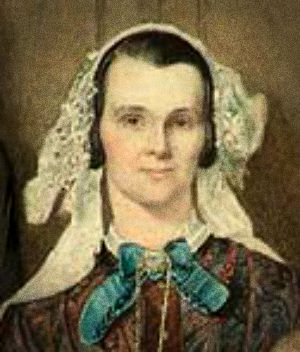
Sarah Pratt
For a review of the Sarah Pratt affair I will refer you to the relevant section in Indecent Proposals, part 1. Hales states that “Even Sarah Pratt, who accused Joseph of making an improper proposal, did not accuse Joseph Smith of threatening to damn her if she rejected.” A review of the statements of Sarah Pratt as given in Bennett’s expose as well as after the fact demonstrate that Hales’ assertion is incorrect.
Remember that Bennett’s account includes the following:
“Sister Pratt, I hope you will not expose me, for if I suffer, all must suffer; so do not expose me. Will you promise me that you will not do it?” … “If you should tell,” said he, ”I will ruin your reputation; remember that; and as you have repulsed me, it becomes sin, unless sacrifice is offered.”
(“History of the Saints” page 231, archive.org)
After leaving the church years later, Sarah Pratt gave additional recollections of the attempted proposal and made this statement:
“If any woman, like me, opposed his wishes, he used to say: ‘Be silent, or I shall ruin your character. My character must be sustained in the interest of the church.'”
( “Mormon Portraits” Wyl, p. 62 archive.org)
Hales is clearly mistaken in stating that Sarah Pratt never made such an accusation.
John C Bennett
The eyes of a scoundrel
Hales goes on to restate his straw man argument about Bennett (discussed above):
“John C. Bennett accused the Prophet of threatening to destroy the reputation of any woman her turned him down, but Bennett is not reliable and no one else made the claim.”
We have established that Hales is mistaken that “no one else made the claim.” We have just seen that Sarah Pratt made this claim in Wyl’s “Mormon Portraits” independent of Bennett and it corroborates the narrative Bennett included in his Expose.
The ‘preferred response’

“A code of silence is usually either kept because of threat of force, or danger to oneself, or being branded as a traitor or an outcast within the unit or organization”
Part of Hales’ argument is that Joseph’s “preferred response” was to “quietly let the matter rest” and I couldn’t agree more. Joseph wanted quiet. The record shows that when the women were quiet, Joseph was quiet – but when the women made noise, then Joseph no longer opted to let matters rest.
In every instance where the prophet’s proposal was refused and then made public the woman was impugned. In every instance where the proposal was refused and kept secret the woman was unmolested. This pattern completely supports the charges put forth in Bennett’s Expose.
Hales has actually helped make Bennett’s case against the Prophet all the more solid for pointing these 5 women out.
The invisible exception
Having already observed that Hales submission is entirely based upon a mischaracterization of the issue (straw man), it is important to look out for other rhetorical shortcomings. One of these is what I refer to as the “invisible exception.” This is where an encompassing claim is made and then an exception is cited which would invalidate the encompassing nature of the claim but it is disguised by minimizing language in the hopes that it is completely dismissed out of hand. This is one of the more brazen pitfalls because it provides it’s own contradiction and sounds authoritative unless you realize the contradiction and point it out.
An example of this would be to say that “Phillip was a completely honest man, even though he showed creativity in reporting his taxes” – the last part of that sentence invalidates the first part – if you understand what is actually meant by “creativity”.

Unanimous (except for that one guy)
There is another famous invisible exception that every Mormon should be familiar with. When the Expositor was published the Nauvoo city council met, deliberated and then voted to have the press destroyed. When the minutes of the meeting were reported in the news paper, this is how the vote was described:
“The following resolution was then read and passed unanimously, with the exception of Councellor Warrington…”
(Minutes of the Nauvoo City council, Nauvoo Neighbor 19 June 1844, archive.org)

related blogpost
Don’t you love it when something is unanimous (except that it’s not). Also – can you guess who the only non-church member on the council was? If you recall from the Conflicted Men of the Nauvoo City Council it was none other than councillor Warrington.
The insidious thing about the invisible exception is that it sort of tells the truth. It includes the facts, but distorts or disguises them in a way that leads you to accept the initial conclusion. Hales statement regarding Joseph’s treatment of the women he proposed plural marriage to could be interpreted this same way. Regarding women who rejected Joseph, Hales states:
“No evidence of retaliatory excommunications or other vengeful reactions have been found, although twice he sought to counteract allegations he considered untrue.”
In the above sections and in the Indecent Proposals article we have documented that Joseph’s actions were significantly harmful to those women’s reputation and may indeed be considered retaliatory. Hales does not point out what exactly Joseph felt to be “untrue” about the allegations. The women that Hales cites did not have retaliation precisely because they did not expose Joseph. Hales’ statement is misleading because if the reader accepts Hales at his word and doesn’t look into the details of what exactly “counteract allegations” means and what Joseph did and allowed to be done to the women, then they are likely to accept the first part of his statement – that there is no evidence.
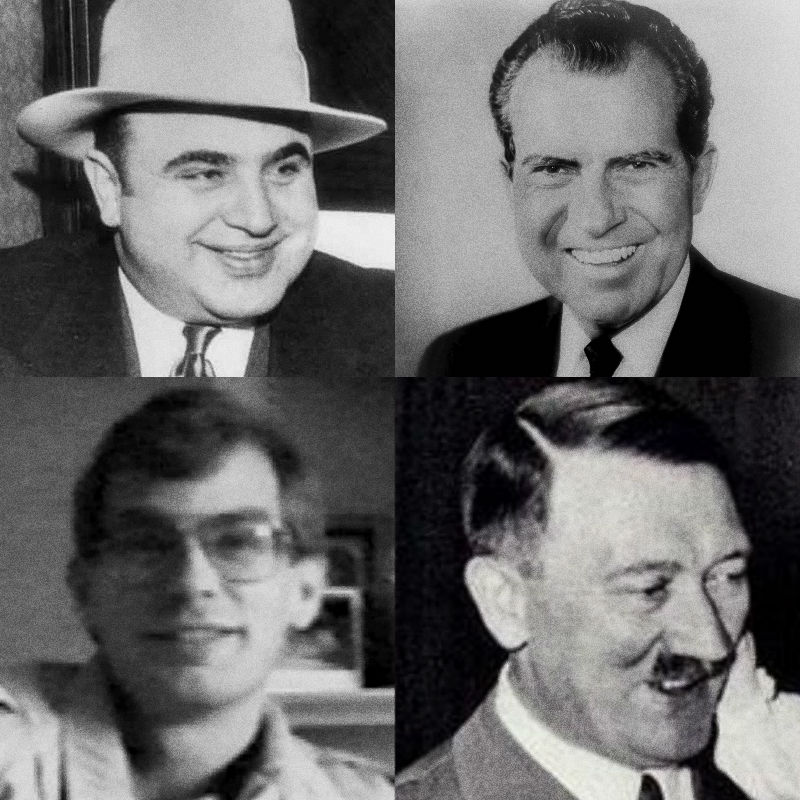
Invisible Exceptions are like linguistic photoshop and can make terrible things seem not so bad.
Invisible exceptions can be an effective way to smooth over controversial information. Hales has crafted a formidable structure to employ it. You could use a similar invisible exception to excuse or minimize any atrocious behavior. For example, we would do this in the case of Al Capone:
“No evidence of retaliatory shake downs or other vengeful acts have been found, although twice Capone sought to assertively persuade some businessmen to pay up what he considered they owed him.”
or Richard Nixon:
“No evidence of abuse of political power or other vengeful acts have been found, although twice Nixon sought to improve communications from people he considered his political foes”
or Jeffrey Dahmer:
“No evidence of cannibalism or other vengeful acts have been found, although twice Dahmer sought to have dinner with people he had previously had conflicts with.”
Okay – in for a penny, in for a pound, we may was well do Hitler:
“No evidence of genocide or other vengeful acts have been found, although twice he sought to clean the genetic pool of traits that he considered undesirable”
 While these example are ridiculous (and will no doubt serve as a distraction for any response Hales may offer) they serve to point out that using such distorted logic and language to whitewash unpleasant realities is dishonest. While the second part of each phrase above is ‘technically’ true – it serves to divert the attention of the reader from the real problem. No one would ever think that creating statements like these ridiculous examples could be an honest defense of these villains. George Orwell noted that such linguistic and logical acrobatics are primarily employed “in defense of the indefensible”((“Politics and the English Language”, George Orwell, archive.org)). Joseph’s actions on the question at hand are indefensible and while Joseph is not a villain like these characters the whitewashing that the invisible exception provides is no less effective or dishonest.
Lucy Walker and Tunnel Vision
From Hales “12 Myths Regarding Joseph Smith’s Polygamy”
There is another rhetorical pitfall that Hales trips over in his defense of Joseph on this issue.
In his discussion on the “12 Myths of Joseph Smith’s Polygamy” Hales makes the use of a quote from Lucy Walker Kimball, one of Joseph Smith’s plural wives. Hales uses the statement to support the notion that women were free to accept or refuse the proposal and he infers that this choice is made without threat or coercion. The quote is taken from an autobiographical sketch found in the church archives and quoted in a published text:
“A woman would have her choice, this was a privilege that could not be denied her”
( “Reminiscences of Latter-day Saints” Lyman Omer Littlefield, pg. 46, archive.org)
This quote in Hales’ argument would seem to very much support his case. Hales is somewhat of a controversial figure among LDS historians and scholars. While his conclusions have both supporters and detractors, he is generally well regarded by all for the fact that his is committed to bringing sunlight to the full documentation of Joseph’s polygamy – even those who disagree with his opinions about their meaning. Collecting and compiling the tremendous volume of documentation is a herculean task and we all have benefited from Hales’ work.

Blinders and Tunnel Vision. Helps prevent one from being disturbed.
His critics have sometimes accused him of tunnel-vision or only using selected quotes which support his position and disregarding quotes from the same source which would defeat that argument. This quote by Lucy Walker Kimball is one which may serve as an example of that. If you read her full account from the original source, and not just the quote Hales provides, then you can see that while “a woman would have her choice” you must remember that in the Mormon doctrine of free agency, choices have consequences. If Joseph instructed her that a decision to refuse Joseph would mean that she would face negative temporal or eternal consequences, then the mere fact that she had a choice does not support Hales position since people who are threatened with destruction or damnation still have a choice.
After making that statement about a woman’s choice, Lucy Walker goes on to describe the struggle that she had in accepting Josephs teaching and proposal.
Lucy Walker Kimball (imagine her as a 16 year old)
“In the year 1842 President Joseph Smith sought an interview with me, and said: “I have a message for you. I have been commanded of God to take another wife, and you are the woman.” My astonishment knew no bounds. This announcement was indeed a thunderbolt to me. He asked me if I believed him to be a prophet of God. “Most assuredly I do,” I replied. He fully explained to me the principle of plural or celestial marriage. Said this principle was again to be restored for the benefit of the human family…. He also said, “this principle will yet be believed in and practised by the righteous. I have no flattering words to offer. It is a command of God to you. I will give you until to-morrow to decide this matter. If you reject this message the gate will be closed forever against you.” This aroused every drop of Scotch in my veins. For a few moments I stood fearless before him, and looked him in the eye. I felt at this moment that I was called to place myself upon the altar a living sacrifice”
( “Reminiscences of Latter-day Saints” Lyman Omer Littlefield, pg. 46-47, archive.org)

There are some important observations to make here. First, remember that Joseph was 37 years old in 1842 and Lucy Walker was 16. She testified in the Temple Lot Case that after her mother died in 1842, she went to live with the Prophet and his family((“Deposition of Mrs. Lucy w. Kimball” Temple Lot Case, Pg. 456 Question 177, archive.org)) and she and her sister and 2 brothers were considered “as members of the one family”((“Deposition of Mrs. Lucy w. Kimball” Temple Lot Case, Pg. 457 Question 183, archive.org)).
If you examine her statement, it mentions that Joseph did actually tell her what consequence she would face upon refusal – “the gate will be closed forever against you”. What gate do you suppose he was referring to? Well, remember in Part 1 that Lucy Walker swore under oath that the revelation from Section 132 was exactly what Joseph taught her regarding plural marriage ((see the section on teaching to the women confirmed in part 1)). It turns out that Section 132 does describe the gate that Joseph is referring to;
“Verily, verily, I say unto you, except ye abide my law ye cannot attain to this glory. For strait is the gate, and narrow the way that leadeth unto the exaltation and continuation of the lives, and few there be that find it, because ye receive me not in the world neither do ye know me.But if ye receive me in the world, then shall ye know me, and shall receive your exaltation; that where I am ye shall be also.”
(Doctrine and Covenants, Section 132:21-23, lds.org)
 The gate refers to the pathway to exaltation. So Joseph as Mayor, Prophet, President, Lt. General and her caregiver and benefactor makes this request of his young ward, who depends on him for her very living circumstances, and does so with all the self proclaimed authority of God Himself and tells her that if she refuses that the gate to God’s presence “will be forever closed against you.”
If you look at the broader context of the quote you can see that the very example that Hales brings to exonerate Joseph actually proves the point that he is arguing against.
Now, Mormons are fond of saying “but she had her free agency!” and this statement usually serves to absolve the authorities from any wrong doing because, the argument goes, that if someone submits to something of their own free will – then it can’t be considered coercive. That is utter nonsense. I have thoroughly explored the problems with that position in the posts on Misinformed Consent. How did she later describe the circumstances of her acceptance of the proposal?

related blogpost
In her deposition in the Temple Lot Case, years later she would describe the event in more dramatic terms:
Q. Can you state the circumstances under which he first taught you that principle?
A. Well, the circumstances were these,—it was a command from God to me to receive it, and I would rather have laid down my life than disobeyed it, but it was a grand and glorious principle that was to be established, and when I was called upon I stepped forward and gave myself up as a sacrifice to establish that principle, and I did that in the face of prejudice, of course. In this day and age we are considered fanatics of course, more or less. I gave myself up as a sacrifice, for it was not a love matter, so to speak, in our affairs, at least on my part it was not,—but simply the giving up of myself as a sacrifice to establish that grand and glorious principle that God had revealed to the world.
(“Deposition of Mrs. Lucy w. Kimball” Temple Lot Case, Pg. 450 Question 29, archive.org)
 It is very clear that she saw no other option. Exaltation to her was more important than life itself. Believing Joseph to be the very mouthpiece of God and hearing such dire warnings, how could she have refused him. To do so would be to sentence herself to eternal damnation, according to the Prophet’s own instruction now found in section 132. Hales confirms that her union with the prophet as a 16 year old girl included full sexual consummation((see Hales “Lucy Walker Evidence of Sexuality” Josephsmithspolygamy.org)). She grew to accept the principle, as did others who were initially repulsed. Since they were given to believe that it was an essential and divinely ordained aspect of God’s law from the Prophet himself, what choice did they really have?
Tunnel Vision – Pot meet Kettle?
Any time you point out a rhetorical shortcoming in someone else, you had better be prepared to be accused of being guilty of the same thing. It is entirely likely that a response to my arguments here will be an exploration of some quote I missed which would appear to provide at least one example where Joseph’s proposal didn’t seem to carry the threat of damnation or reprisal.
I too am guilty of tunnel-vision. It’s very hard to avoid. Confirmation bias is very hard to avoid, even when you try to guard against it.
It turns out that such biases and rhetorical shortcomings don’t necessarily invalidate your position. It depends upon what your position actually is.
Imagine that you are a doctor looking for evidence of lung cancer in your patient. Your patient is really healthy – he works out, he is a great asset to his community, he is always helping widows and baking cookies for people and he is phenomenally wealthy. We really want to guard against cancer, though, because if we find any evidence of it at all, particularly if it is aggressive, it has very significant consequences. You obtain a chest x-ray to look for evidence.

Tunnel Vision – Look at all that healthy looking lung!
On that x-ray the overwhelming majority of the lung looks completely healthy. There is just this… thing… up in the top of the left lung. But let’s not worry about that. The patient just seems so tremendously healthy and full of vigor that you show him the x-ray and simply just point out all the nice looking healthy lung. the patient sees the abnormality in the left upper lung and asks you about it, but you respond that other than that one region – all of the other lung looks completely healthy! You invite him to go back to his routine and give it no more thought.
Now if you were the patient – would that type of tunnel vision be okay to you? It is true that all that other lung looks really healthy, but does that matter is there is a cancer up in the corner?
I suggest that if you were the patient the exact opposite would be true. Your tunnel vision would focus completely on the cancer in the left lung because it doesn’t matter if the entire rest of the lung looks absolutely perfect – the fact that there is a cancer there means that there is a problem that needs to be addressed. If the doctor were to tell you “Stop focusing on that little cancer and ignoring all the good healthy lung – get over your tunnel-vision on that cancer!” then I am confident that you would say that it is time for a new doctor.

related blogpost
This principle is not just true in the realm of medicine. If you discover evidence of child abuse, you don’t cite all the times when the abuser is kind to children as a reason to look the other way. If you discover a financial Ponzi Scheme, you don’t use the payments are occasionally made to some investors as defense of the perpetrator. If you catch a serial rapist, you don’t cite all the non-coercive interactions they have with people everyday as reason to give them a pass. In all of these cases what is considered “tunnel vision” is really just a focus on an impeachable offence. If the critical issues which attract tunnel vision in these examples are true, then none of the other aspects really matter.

Which Scientology splinter group holds the true teaching of Hubbard and why don’t Mormons care?
When Mormons look at other religions – they draw similar conclusions. There is no point for a Mormon to delve into doctrinal minutiae of Scientology or the Church of Christ Scientist because they are not rooted in “the proper authority” and so they are false. Mormons would have tunnel vision on that fact and it would impeach any other significant factor about them on the question of true religion. For a Mormon evaluating other religions, proper authority is a critical issue.
Any rebuttals that focus on some niceness that Joseph showed to some person will be ineffective, unless it can be demonstrated that Joseph did not find it necessary to commit or tolerate the reprisals on someone for publicly disclosing the fact of his plural marriage doctrine and proposal.
Using tools to Pick Nits
In Hales’ conclusion he states:
Look at all those nits! just ignore them?
“Personally I think this whole exercise is nit-picky, but someone referenced it and so I’ve taken the time to respond. When it comes to Joseph Smith and plural marriage, I would also recommend that you read what the believers had to say as well as the unbelievers. We wouldn’t want to embrace a skewed view of what happened would we? Both views are referenced in my books, JOSEPH SMITH’S POLYGAMY: HISTORY AND THEOLOGY.”

The “whole exercise” that Hales is referring to is that of trying to determine the truth. If the Expositor did not lie in its allegation about Joseph Smith, then there are serious implications. It means that the church is being dishonest when it teaches primary children that the men who published it told “vicious lies” about Joseph. It means that the retaliation against those men orchestrated by Joseph was not an attempt to counteract allegations, but instead was an attempt to silence those who would tell the truth and expose his illegal activities which he had been lying to cover up. It means that church members today have to come to a more complex understanding of Joseph which includes the realities of retaliation towards women, outright lies, and a God who would allow his divine laws to be enacted in such a way.

Left unpicked, nits become lice… don’t just ignore them.
When you examine political propaganda you have to be nit picky. The lies, distortions and obfuscations are designed to divert your attention away from unpleasant realities. If you accept them without critical assessment, then you are likely to find yourself tolerating or supporting things that you otherwise would be opposed to. This is true of religion as well. Other religions have their own nits – Jehovah’s Witnesses reinterpret and falsify the original predictions of Charles T Russell to maintain his image and Christian Scientists deny that Mary Baker Eddy derived her teachings from spiritual healer P.P. Quimby. These distortions paint a faith promoting image of the founders of those faiths, keeping the members with a false idealized view. Mormons wouldn’t criticize members of those faiths for critically examining those issues – they would encourage them to pick away at those nits!
The difficulty comes in seeing that the same strategies are being employed in order to maintain a faith-promoting illusion of LDS founder and history. Why should members of those other faiths pick their nits, and yet Mormons should leave their alone, confident that the flecks and blemishes are nothing? Hales encourages people to read both the faith-promoting perspective as well as that of the “unbelievers.” I have no difficulty agreeing with him on that point. When you examine those perspectives, I encourage you to apply the concepts of S.T.E.E.L. tools((Seeking Truth by Education Erudition and if necessary Liberation – an approach to a faith crisis which encourages learning from all sources and critical evaluation of explanation and rationales given by any source. Such a method would be essential for someone to escape from a high control group such as scientology or Jehovah’s Witnesses. See the “Fix your Faith Crisis with this One Weird Trick” post for details)) and look out for the W.O.O.D. ones.((Ways Of Overcoming Doubt – explanations and rationals which serve to suppress doubt but limit the extent of research, analysis and knowledge one may pursue in order to maintain faith in a person or group. Such an approach to a faith crisis would keep one trapped in a high control group such as Scientology or JW. See the “Fix your Faith Crisis with this One Weird Trick” post for details))
Conclusion – Final
In this 3 part response to Brian Hales submission we have established that the actual claim made in the Expositor was factually accurate and represented a reference to the warning included in Section 132:4, which the authors of the Expositor were familiar with and which women approached by Joseph confirmed matched their instruction by him (see part 1). We further explored the 5 examples Hales proposed as proof that Joseph was not retaliatory and showed that Hales case was weaker than he made it out to be, with only 2 of those 5 actually documenting a proposal. Furthermore we demonstrated that the authors of the Expositor could not have known about them and so any claim in the expositor on that issue was made in good faith and hardly a “vicious lie.” (see Part 2). Finally, in part 3 we have examined the premises of Hales’ argument and discovered that it is a straw man of the actual allegation of Joseph. The actual allegation made by John C Bennett and other contemporaries is that he retaliated against women who would publicly expose him – not simply women who rejected him. We have further examined rhetorical pitfalls of tunnel vision and the invisible exception to illustrate some problems with the explanations and rationalizations used to defend the indefensible.
I want to thank Hales for taking the time to consider the challenge to find a “vicious lie” in the Expositor. If he is able to rebut the information presented in this response, I look forward to it. Doing the research to examine this and other possible lies in the Expositor has provided a unique window for me to examine LDS history. Going in to this issue, I was not certain that as strong a case against Hales’ argument could be made as what exploration of the context ultimately provided. If Hales continues to use these 5 women to defend Joseph on this point in the future it is my hope that he would do so with an acknowledgement that there are legitimate reasons to see his treatment of the women who exposed him as retaliatory and that the record shows that his proposals included a threat of such.

The accusations against Joseph Smith Jr. where not the inventions of ‘scoundrels’; that is such a weak argument. You have done a good job of refuting that tired stance.
“I had not been married scarcely five
minutes, and made one proclemation of the Gospel, before it was
reported that I had seven wives….This spiritual wifeism! Why, a
man does not speak or wink, for fear of being accused of
this….What a thing it is for a man to be accused of committing
adultery, and having seven wives, when I can only find one. I am
the same man, and as innocent as I was fourteen years ago; and I
can prove them all perjerurs”-Joseph Smith (History of The
Church 6:410-411)
The statement I come away with is this, “I am
the same man, and as innocent as I was fourteen years ago”.
I believe he was innocent, i.e. “not guilty of a crime or offense.” perhaps not by the courts or the minds of his fellow man as rendered in the Expositor, but I believe that before god he was blameless. The lie of the expositor was, in my opinion, more to the effect of the conclusion a reader was to draw from reading about this in the paper, that Joseph had anything in his heart but righteousness and had anything in his purpose but the will of the lord.
I think it is an interesting paradox that we learn line upon line, yet firmly believe that partial truths can do a lot of harm. We also know that there is knowledge we are not prepared to receive, yet what do you do when the adversary thrusts you, a servant of the lord or a saint, into a situation where this order or precept is violated?
I thought there was some phrase like “Public nuisance” that was levied against the expositor, not “vicious lies”, yet , as you say, the primary manual says “vicious lies”. Is it a vicious lie that the prophet will lead its people to do wickedly or away from Christ or to serve his own carnal gratification? What is implied by the statements in the expositor? The church members and leaders today have the same information we as individuals do and they have offered a narrative to the revealed prophecies and revelations the Lord wishes us to have. I think it also interesting to countenance the idea that there might be some commandment of the Lord we might shrink and not do or at least want to do. Is not doing as the lord asks, sin? Is there agency when one choice is the right choice and not to choose it is the wrong one or one that denies you the blessings of the eternities? Good questions indeed, I can only make observations.
It isn’t clear to me that a narrator from the church needs to sift through history books and offer a blow-by-blow of the accounts presented there, sifting the accounts as you might wish them to do. They are available, in some cases on the church website, some in its own historical archives, some at BYU, etc. It is an interesting exercise to create a playbook with a set of standards that you deem as incontrovertible. There is a pattern where we can do our research, apply our thoughts and efforts to obtain answer and where we lack wisdom, we can obtain answers we seek through other means…but here again it is also true that sometimes the answer is “not now.”
It’s also always interesting to me when you get a peak behind the curtain before you’re supposed to, you actually expect not to be surprised or unprepared for what you discover.
I thought you said you avoided wading into my blog 😛
” The church members and leaders today have the same information we as individuals do and they have offered a narrative to the revealed prophecies and revelations the Lord wishes us to have.”
Have you considered what they have to gain by keeping the system going and what they have to lose by denouncing it?
“I believe he was innocent, i.e. “not guilty of a crime or offense.” perhaps not by the courts or the minds of his fellow man as rendered in the Expositor, but I believe that before god he was blameless.”
That is a stretch, particularly when the Church specifically says that it believes in being subject to the laws of the land. He was giving those statements in defense to charges of adultery which were being brought against him – not to mention that any plural wife was a violation of bigamy laws. Any man claiming divine right could do things as bad as murder and feel that they were blameless before God – that is what suicide bombers do. Is that really the moral footing a Prohpet of God has to stand on?
“I think it also interesting to countenance the idea that there might be some commandment of the Lord we might shrink and not do or at least want to do. Is not doing as the lord asks, sin? Is there agency when one choice is the right choice and not to choose it is the wrong one or one that denies you the blessings of the eternities? ”
Even Joseph couldn’t tell the difference between a commandment from God and one from Satan – look at his “revelation” to sell the copyright for the Book of Mormon for evidence of that. Additionally we know that mental disorders such as scizophrenia are real and can include voices giving commands. Since commands like “kill your son” or “marry a 15 year old” are so strictly in opposition to the most highly regarded notions of morality – it is safer to assume that if you have been given such a commandment it is either from Satan or due to a mental disorder. You should not do them yoruself or tolerate them in anyone else, no matter how much religious authority they claim.
” There is a pattern where we can do our research, apply our thoughts and efforts to obtain answer and where we lack wisdom, we can obtain answers we seek through other means…but here again it is also true that sometimes the answer is “not now.””
Because of a strategy of first presuming the church is true and Joseph is not a charlatan and then looking only for ways to make data fit that narrative, there are going to be many instances where the answer will be “not now.” Since you are waiting for way that the facts will line up with that preconception, the fact is that the real answer is “not ever” it is just an unacceptable conclusion for you and so you wait…
I see you didn’t even touch my assessment of the Expositor. Meh, I am no Brian Hales. So whatev’s.
It’s a question to be sure. What would they (the leaders) lose? What would they gain? What if the Lord told them “not now” or the heavens remained closed regarding church history? Then you have to push the question up higher, I guess. The truth IMO is, that’s not the stewardship the church has been entrusted with. It is guiding it’s members to learn the will of god, then to do it, seeing to their temporal and spiritual needs, ministering the ordinances of the gospel with authority. Does “Press forward” sound like a familiar refrain?
Ah! you may exclaim, it is the authority which is in question. But then if you receive an answer to your prayers from your heavenly father, what higher authority can their be. Ah! yet again you exclaim, the spirit is an unreliable source of truth. Yet it is that fountain which guided the prophets in the scriptures, it is by the power of the spirit that all things were created. It is also the gift or comforter left to us by Christ. If you denounce these gifts and our own ability to seek knowledge from god, then it is you who denounce Christ as a fool, not Joseph Smith. I say it is not the SPIRIT which is an unreliable source of TRUTH, it is MAN which is an unreliable source of RIGHTEOUSNESS and the Spirit of God cannot dwell in unholy temples[1]. Perhaps I am running through the arguments a little quickly, but you and I both know we’ve been up and down this road many times before, so I won’t pretend this is a “game changer”.
I have kids and they always fight and tell me “So and so always get’s their way, I never get things my way”. As a result, I’ve actually tried to dispel this myth by trying to note when they got their way even going so far as to actually stage instances with dates and times where they got their way so as to nullify this argument so they can never say “never” or as the case may be “not ever”. I don’t think I’ve had very much success. I doubt very much that you or anyone can divine the lord’s time table and say with eternal confidence “not ever”. You stumble over your own convictions by doing so, since you prize new information which may shed light on previously held misconceptions. I think it interesting that you blackball LDS beliefs[2] , but you’re giving your “belief system” a pass based on conclusions which are held together with morsels you’ve retrieved from the garbage pile of history, brushed them off and placed your trust in the hope that they are untainted and free from meddling. I suppose there is great wisdom to be found in dumpsters such as “Discarded pizza boxes are an inexpensive source of cheese.” – Herb, Homer’s estranged brother (don’t forget the wisdom of survival found in “secret Hobo spices”).
Regarding Joseph’s doubts or what other people said his doubts were 57 years after the fact or what he did or did not say outside of the Doctrine and Covenants, Pearl of Great Price or The Book of Mormon, I’m going to put a pin in it…BOOP![3] Or rather I choose to believe that Joseph had the wisdom to know the difference, nevertheless it would be folly not to acknowledge that the adversary is real. We observe that prophets have moments of weakness from the example of Lehi, a visionary man, who murmured against the lord[4] to Moses who began to fear the adversary exceedingly[5] there is ever the need to put on the armor of god and turn to the Lord for strength. But that’s not what I’m shoveling.
That you directly renounce the bible account of the commandment of the lord to Abraham to sacrifice his son is interesting, giving a prophet of the lord over as a mad man who hears voices[6] (he certainly did hear voices). Perhaps you go as far to say the promises he obtained from god were delusions. I think many people would take issue with any of that, but then again, perhaps many people take issue with my view. I wonder how much heed a mad man would give to voices to NOT sacrifice his son? Most people I would think would be driven insane at the prospect of losing a son they had waited over a century to know, but that usually comes after, not before. Abraham himself was once on an altar to be sacrificed[7]. He remains a man who is revered by ALL blood descendants of Abraham through out the bible, Jesus himself and through whom every member of the LDS church and perhaps all christendom lay(s) claim on the blessings of the Father and who is, according to you, a fruit loop.
I suppose it is perplexing, perhaps understandable, being a former mormon who might question the “translated correctly” portion of the bible, yet the bible is fraught with examples that are a type of things to come. Isn’t the savior a.k.a. the lamb of god, the son of our father in heaven? Isn’t that exactly what he (Our eternal father) had to do to overcome sin and death for the rest of his children?
I disagree. I should not wait for the facts to line up. Exercising faith requires us to prepare NOW, believe and act with the assurance that we are doing the right thing NOW, not blindly, but with confidence we find through indirect means. Such as by receiving blessings of wisdom and spiritual confidence through following the prophet’s counsel, reading the scriptures and growing our relationship with our heavenly father through prayer and obedience. I can understand why you might want to wait, even Thomas defined the conditions for his belief in the resurrected savior, though I suppose there are at least a few examples of people I can think of who set the bar too high and suffered because of it.
The reason Joseph Smith was a remarkable man to me is in the revelation of the Book of Mormon. It is on the virtue of the remarkable teachings and examples I find in that book that encourage and explain so much about faith and living righteously through the lives of men which are unmistakably men of god and Jesus Christ.
To butcher what you said to me and turn it on it’s head, “Because of a strategy of first presuming the church is false, Joseph is a charlatan and then you go looking only for ways to make data fit that narrative, there are going to be many instances where the answer you find will be “looky here” or “ah hah!” Since you are lining the facts with that preconception, the fact is that the real answer eludes you, because you’ve already reached an acceptable conclusion for you and so you don’t wait…” I’ve often said, the answer you are looking for is always in the last place you look. What kind of idiot keeps looking for something after he has already found it? I guess maybe we’re all a little dain bramaged, but I suppose you know that better than anybody.
Well, I’ve wasted enough of your time again, and I need to get some sleep. I should probably shut up as well, I think my comments are pulling away from the actual topic that you want to focus on here. Sorry, I know I’m thick headed, because of that and more you and I are stuck with each other. I’ll keep setting them up, I’m sure you’ll keep knockin’ em down. Peace.
[1] Helaman 4:24; https://www.lds.org/scriptures/bofm/hel/4.24
[2] Articles of Faith 1:9; https://www.lds.org/scriptures/pgp/a-of-f/1.9
[3] https://www.youtube.com/watch?v=EiCvyLZGgnA
(Oh man, I can almost hear the face desk action that is happening on reddit now.)
[4] 1 Nephi 16:20; https://www.lds.org/scriptures/bofm/1-ne/16.20
[5] Moses 1:20; https://www.lds.org/scriptures/pgp/moses/1.20
[6] Genesis 22:1,2,11,12,15-18; https://www.lds.org/scriptures/ot/gen/22.1,2,11,12,15-18
[7] Abraham 1:15; https://www.lds.org/scriptures/pgp/abr/1.15
(Uh-oh, Jeremy Runnell-ites are making my tin foil hat tingle.)
I’m sorry, I didnt realize that you had made an attempt to address the Expositor. I guess it its this statement:
“The lie of the expositor was, in my opinion, more to the effect of the conclusion a reader was to draw from reading about this in the paper, that Joseph had anything in his heart but righteousness and had anything in his purpose but the will of the lord.”
If the factual statements in the Expositor are accurate, which I have defended up to this point, then it is implicit that the men of the Expositor are accusing Joseph of having things other than righteousness and the will of the Lord in mind. So whether or not your conclusion is true depends on whether or not the statements of the Expositor are factual.
Regarding the factual account of Abraham and his sacrifice – do you believe that Job and his story are literally real? That story is universally considered to be a morality play. Were Adam and Eve the sole couple from which all of humanity came? Was the Flood in the bible a literal event? The bible is full of mythology and allegory. There are good things to be had there, but there are also atrocious things there. You can use Christ’s injunction of the Golden rule to discern what should be revered from what should be dismissed. Stories in the Bible should never be used to justify violating what we know to be morally wrong, as Joseph Smith did in his plural marriages and Brigham did on the subject of Blood Atonement and racism.
“Ah! yet again you exclaim, the spirit is an unreliable source of truth. Yet it is that fountain which guided the prophets in the scriptures, it is by the power of the spirit that all things were created. It is also the gift or comforter left to us by Christ. If you denounce these gifts and our own ability to seek knowledge from god, then it is you who denounce Christ as a fool, not Joseph Smith. I say it is not the SPIRIT which is an unreliable source of TRUTH, it is MAN which is an unreliable source of RIGHTEOUSNESS and the Spirit of God cannot dwell in unholy temples[1].”
This statement is betrayed by Mormon History. The fountain which guided the Prophets also had them believe Adam was God, Black people were inferior, and Blood Atonement was a thing. You will no doubt reply that whenever things claimed to be done by the spirit turn out to NOT be the truth, then it was just the unrighteousness of Man. that is a standard that will allow you to be fooled by any religious charlatan.
“I disagree. I should not wait for the facts to line up. Exercising faith requires us to prepare NOW, believe and act with the assurance that we are doing the right thing NOW, not blindly, but with confidence we find through indirect means. Such as by receiving blessings of wisdom and spiritual confidence through following the prophet’s counsel, reading the scriptures and growing our relationship with our heavenly father through prayer and obedience. I can understand why you might want to wait, even Thomas defined the conditions for his belief in the resurrected savior, though I suppose there are at least a few examples of people I can think of who set the bar too high and suffered because of it.”
That is fine – but you have to keep in mind that what you are having Faith in is Joseph Smith – NOT Jesus Christ. There are many Mormons who have left Joseph but still revere and have faith in Jesus. Joseph is just one of a long line of people who have required faith in more than Christ in order to be saved. Keep waiting for Joseph smith to be proven right, just as the JW’s are waiting for Charles Russell to be proven right and the Christian Scientists are waiting for Mary Eddy Baker to be proven right and so forth.
“The reason Joseph Smith was a remarkable man to me is in the revelation of the Book of Mormon. It is on the virtue of the remarkable teachings and examples I find in that book that encourage and explain so much about faith and living righteously through the lives of men which are unmistakably men of god and Jesus Christ.”
I could take a science text book and copy facts and material from that textbook into another book and claim that an angel “gave it unto me” and then people finding true facts in that book could make the logical leap that since they found good things in that book – they should also believe my story about the angel, and by extension believe anything else that I came up with as true. Just because there are things that you find good in the Book of Mormon doesn’t mean that it is legitimate, nor does it mean that Joseph is. Have you done a study of how much the Book of Mormon is derived from the specific version of KJV bible that Joseph had access to? I will send you a PDF on FB with a study of that – it is fascinating.
“”Because of a strategy of first presuming the church is false, Joseph is a charlatan and then you go looking only for ways to make data fit that narrative, there are going to be many instances where the answer you find will be “looky here” or “ah hah!” ”
The more closely you look, the more closely the data corresponds to that narrative. It is not a matter of me having confirmation bias. Confirmation Bias is what led Hales to the conclusion he had about what Bennett actually claimed and the use of Lucy Walker’s quote and so forth. I lived a life of presuming the Church to be true and Joseph to be authentic. That was my bias. It was only after I kept coming across information that betrayed that bias that I eventually let it go and accepted that the overwhelming record of history points to his illegitimacy as a prophet and the products be brought out in the Book of Mormon, Book of Abraham, revelations in the D&C are all just as illegitimate – not because Joseph is false, but because you can examine each one independently and find they are certainly not of divine origin.
Science changes it’s position to account for evidence. What you have proposed is perpetual ignorance or disbelief in the evidence in order to preserve belief in Joseph. You do it is tems of righteousness and humility and I think you come to it sincerely. Just realise that the followers of Charles T Russell and Mary Baker Eddy do too.
Also, by using the lable “Runnell-ites” you are falling into the trap of assuming that people only leave Mormonism by following some other person. Runnell summarized problems in the church in a single document. People that read that and then find their way out of the church do so not based of Runnells word alone but also with their on confirmatory study. Runnell does not expect people to follow his personal belief system. There are people who support him and are grateful to him, but nobody believes that he is a means to personal salvation in the way that religious leaders claim. There are Snuffer-ites, there are Nemelka-ites – There are no Runnell-ites
It’s interesting that the women that rebuffed Smith suddenly were whores or prostitutes . So why then is he trying to tap such a horrible sinner(s) ? He was the whore . Lies were his greatest accomplishment .
Bravo! That was magnificent to read. The Van Allens give it 4 thumbs way way up!